How Does a Queue Management System Work? Full Guide for Clinics
Key takeaways
- A queue management system holds the order, updates wait estimates, shows the now-serving token, and messages the patient when their turn is close.
- The useful loop is six steps: issue, place, estimate, notify, call/display, close and log.
- Hardware (kiosks, ticket printers) is optional for small clinics; WhatsApp plus any TV covers most of the job.
- The features that change an OPD day are per-service queues, walk-in tokens, 2-ahead reminders, a live display, and one-tap reordering.
What is a queue management system, in one paragraph
What is a queue management system? It is software that replaces the physical act of standing in line, or sitting in a waiting room guessing. The system holds the order, updates it when things change, shows it on a screen, and messages the patient when their turn is close. Beyond that, products differ mostly in how the token is issued, how the patient is told, and how many parallel lines you run at once.
Two phrases get mixed up. Queue management software usually means the application layer: the dashboard, the logic, the messaging. A queue management system device is the hardware some vendors bundle with it (a kiosk, a ticket printer, a counter display). The hardware is optional. In small clinics it is often the part you can skip. The software version does the same job without paper, and reaches the patient outside the building.
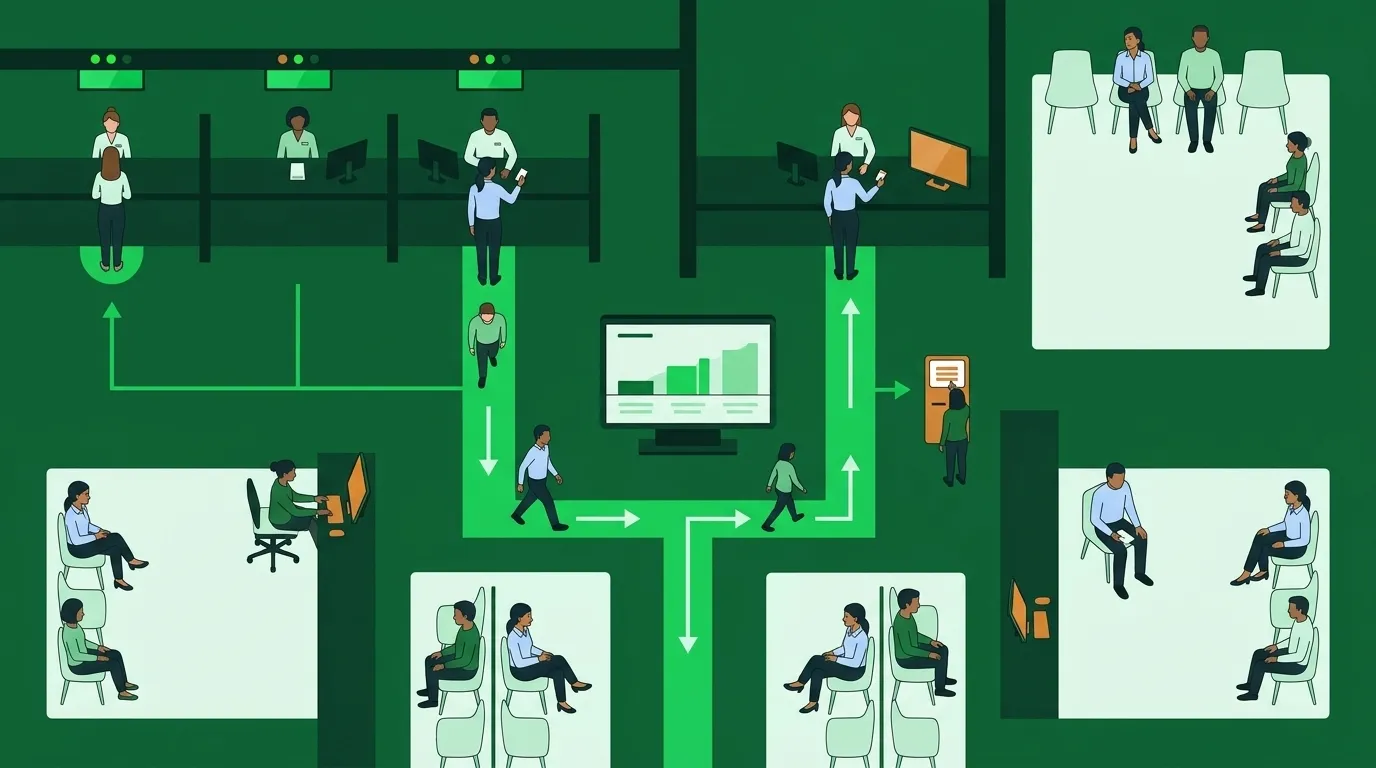
How a queue management system works, step by step
Here is the full cycle for an outpatient clinic, from before arrival to after consultation.
Token issue. The system assigns a number and records which queue it belongs to: Dr Rajan's queue, the optometry queue, the sample collection queue.
Queue placement. A better system checks whether this queue has a different service time from others, and whether the patient is a review case or a first visit.
Estimation. It calculates an expected time using minutes-per-patient for that specific queue and the number of people ahead.
Notification. This is the single step that converts a waiting room into something calmer, because people wait where they want to wait rather than on your bench.
Call and display. When the doctor is ready, reception calls the next token and the waiting-room screen shows it.
Close and log. The session is marked complete and the day's timings are recorded, so tomorrow's estimates start from real numbers rather than guesses.
That is how a queue management system works at its simplest. Everything vendors add on top (analytics, AI, multi-branch dashboards) sits around this loop.
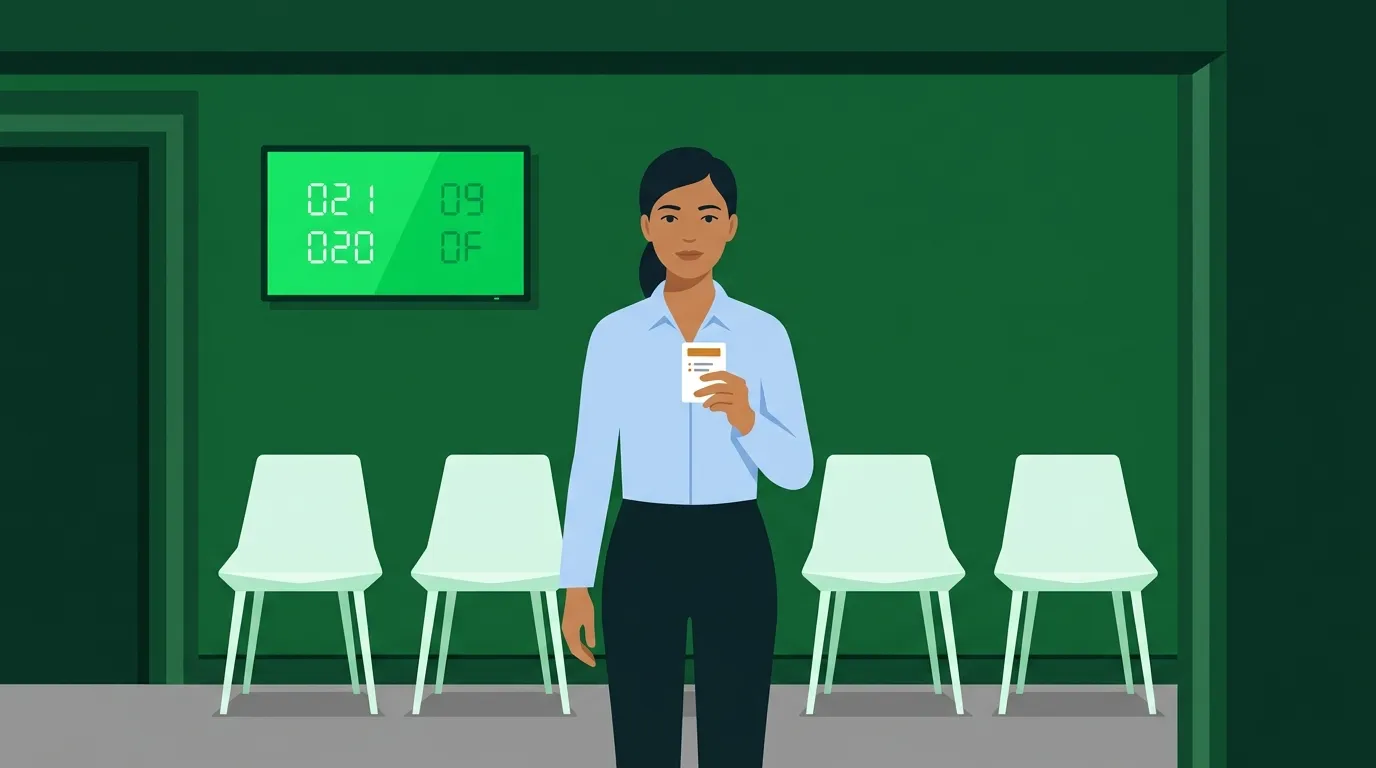
What is the purpose of queue management system software?
Ask ten clinic owners and you get ten answers about reducing crowding. Crowding is a symptom.
A patient who knows they have a ninety-minute wait and can spend it at home is not an unhappy patient. A patient who has waited forty minutes with no idea whether it is five more or fifty is already composing the review in their head.
The second purpose is protecting the front desk. A receptionist who answers "how much longer?" every few minutes cannot do registration, billing or phone bookings properly. The third is visibility for the owner: without a system you genuinely do not know whether Tuesday evening runs forty minutes behind every week, or whether that was just last Tuesday.
There is a fourth purpose nobody puts on a brochure. It catches silent churn. Patients who had a bad wait rarely tell you. A queue log at least shows which sessions ran long, so you can connect a drop in returns to the days that caused it. More on that psychology in why patients leave clinics over waiting time.
Types of queue management system you will come across
The types of queue management system on the market differ mostly in where the patient is when they are queued.
Physical ticket systems. The patient takes a printed number at the door and waits for it to be called: the oldest version of the idea, still common in government hospitals.
Kiosk-based systems. Hardware typically runs ₹30,000 to ₹80,000 once you include installation, then keeps costing in annual maintenance. Modern kiosks are marketed as AI-ready with larger touch targets, audio prompts and multiple languages.
Virtual or remote queueing. This is where an e-queue management system differs most sharply from a ticket dispenser: the queue exists before the patient arrives.
Appointment-led systems. These assume every patient shows up at their booked slot, and that walk-ins are rare enough to absorb. In most Indian OPDs neither holds reliably, which is why appointment-only setups drift into chaos by mid-morning.
Hybrid systems. These combine booked slots with a live walk-in queue, so both kinds of patient share the same session without either breaking the other's estimate. The types that survive in small practices tend to be hybrid ones, because they do not demand that patients change how they behave. See tokens vs appointments for the trade-off.
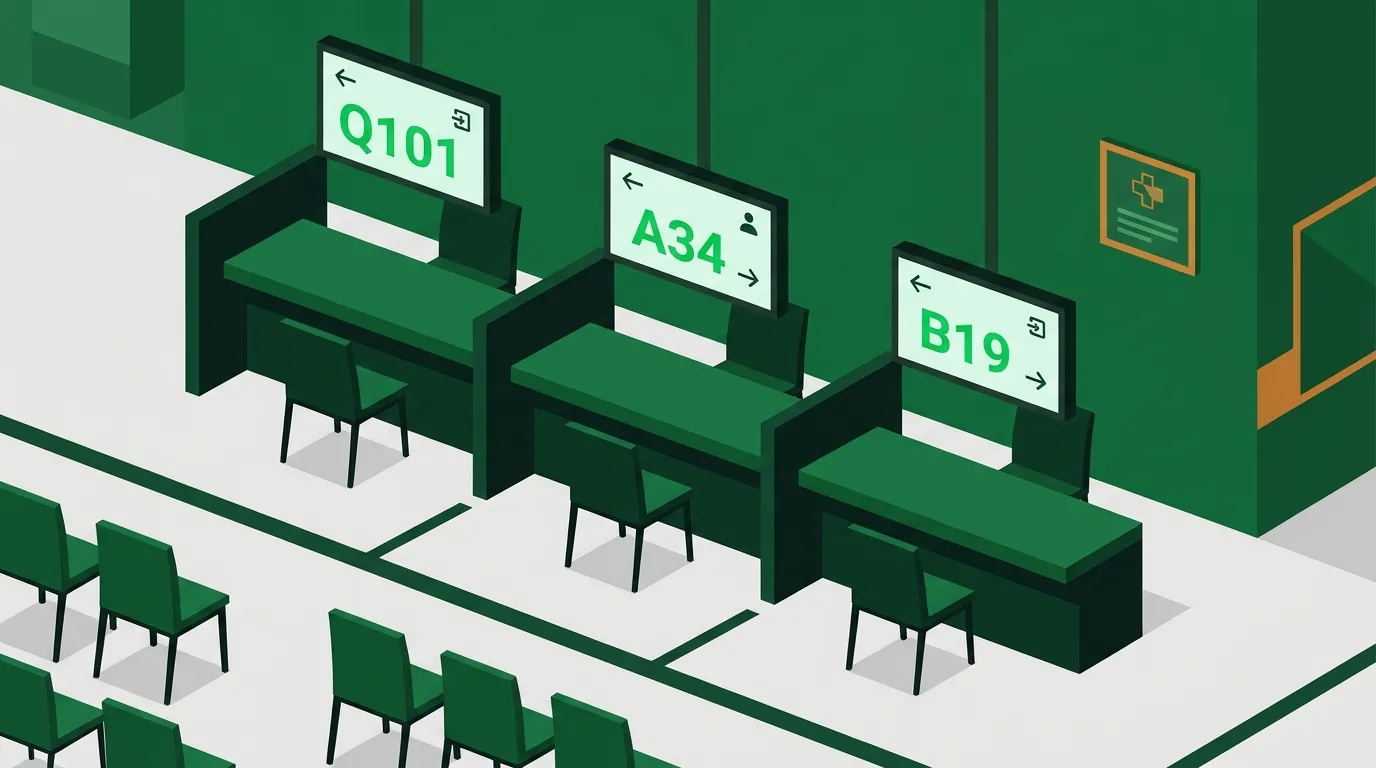
Electronic, digital, e-queue and smart: what the labels mean
An electronic queue management system is any system where the token and the display are electronic rather than paper. That covers a kiosk with a counter board.
A digital queue management system usually means the same thing with the emphasis on software: a dashboard, a database, reporting. The distinction is largely marketing vintage. You will see it most in tender documents and government hospital specifications.
What is a smart queue management system, then? One that changes its estimates based on what is actually happening: the doctor who started twenty minutes late, three long consults in a row, a lab with a collection backlog. A counting system just says "you are number 14". If a vendor calls their product smart, ask one question: does the estimate change during the session, or is it calculated once at token issue?
Real-time queue intelligence without buying infrastructure
The most interesting shift in queue systems over the last couple of years is that throughput improvements no longer require new hardware. Outside healthcare, fuel stations have reportedly improved vehicle throughput using real-time queue intelligence alone: no new pumps, no new bays, just better sequencing and better information to drivers.
The same logic applies to an OPD. A meaningful share of your lost capacity is not clinical. It is patients who are not in the right place at the right moment, doctors waiting while the next patient is found, and reception resolving confusion instead of moving the line.
Real-time intelligence means the system knows, right now, how long the current consult has been running, how far the queue has slipped from plan, and which patients need re-notifying as a result.
This matters for budgeting. Clinic owners often frame queue improvement as a capital question (a kiosk, a display wall, a counter system). It is usually an information question. The infrastructure you need is a screen you already own and a messaging channel patients already use. Over three years a kiosk plus AMC can cost tens of thousands of rupees; a mid-tier software plan is a fraction of that, and buys the thing that actually moves the queue. Our kiosk comparison spells out the trade-off.
AI and adaptive algorithms: where machine learning genuinely helps
There is real research behind adaptive queueing, and it is more specific than "AI-powered" on a feature list. Some healthcare queueing work explores reinforcement learning, where the system adjusts rewards and costs as conditions change through the day. In plain terms, the algorithm learns that a 9am slot behaves differently from a 1pm slot, and stops applying the same rules to both.
Why that matters to a clinic: time-varying conditions are the whole problem. Your morning session has fresh cases and a doctor who is on time. Your evening session has reviews, walk-ins who finished work, and a doctor who started late because of a procedure. A fixed minutes-per-patient figure is wrong in at least one of those sessions, always.
Where machine learning helps honestly: learning each doctor's real pace rather than the pace they told you at setup; spotting that a particular service consistently overruns so the estimate stops lying; adjusting notification timing so the 2-ahead reminder lands when it is genuinely useful.
Where it is oversold: predicting no-shows with confidence, promising specific wait reductions, or claiming to optimise a queue it has only three weeks of data on.
Our position is unfashionable but practical. Most small clinics do not need reinforcement learning. They need a separate queue per service with its own minutes-per-patient, which fixes the largest source of wrong estimates before any algorithm gets involved. Adaptive learning on top of honest segmentation is valuable.
What it costs at low volume, and where the hidden charges sit
This is the section most explainer articles avoid, and it is the one that decides whether you adopt anything.
The pricing problem for small operations is structural. A clinic doing around a thousand patient visits a month is too big for paper and far too small for enterprise platforms. Major queue platforms often start well above

