Token system vs appointment system for clinics: which one fits your OPD
An appointment system books fixed time slots; a token system issues sequential numbers and serves them in order. Appointments work when consultations are predictable in length and patients are punctual. Tokens fit walk-in-heavy clinics where consult length varies. Most Indian OPDs run as token queues in practice, whatever they call it, because real consult times rarely match the slot.
How the two systems differ
An appointment makes a promise about a time: come at 11:00. A token makes a promise about an order: you are number 14. The first promise is broken by one long consultation, because every later slot slides and the 11:00 patient is seen at 12:30. The second promise cannot be broken by a long consultation, because the order does not change; only the wait does. What patients resent is not waiting, it is waiting after being promised they would not.
The catch with a plain token is that "number 14" tells the patient nothing about when to leave home, so they arrive at opening and the room fills. That is the gap the hybrid closes.
Side by side
Three columns, because the choice is not really binary. The third is what TOKENN does.
| Appointment system | Plain token system | TOKENN: tokens with a live estimate | |
|---|---|---|---|
| What the patient is told | A fixed time | A number | A number, an estimated wait, and an arrive-around time |
| When a consult runs long | Every later slot is wrong | Order holds; wait grows silently | Order holds; the estimate updates and the 2-ahead reminder lands later |
| Walk-ins | Squeezed in, or turned away | Take the next number | Take the next number in two taps at reception; same queue |
| Emergencies | Reschedule everyone | Argue at the desk | "Call now": seen next, everyone else shifts by one |
| No-shows | A dead slot | A skipped number | Cancel by message; the slot goes to the next patient |
| Front-desk load | Booking, rebooking, apologising | "What number is on now?" all morning | The assistant answers status; the desk handles exceptions |
| Booking ahead | Yes | No | Yes: a number before opening, with the opening time and place in line |
| Best for | Uniform visit lengths: fixed physio sessions, vaccination slots | Pure walk-in counters | General OPD and most specialty clinics |
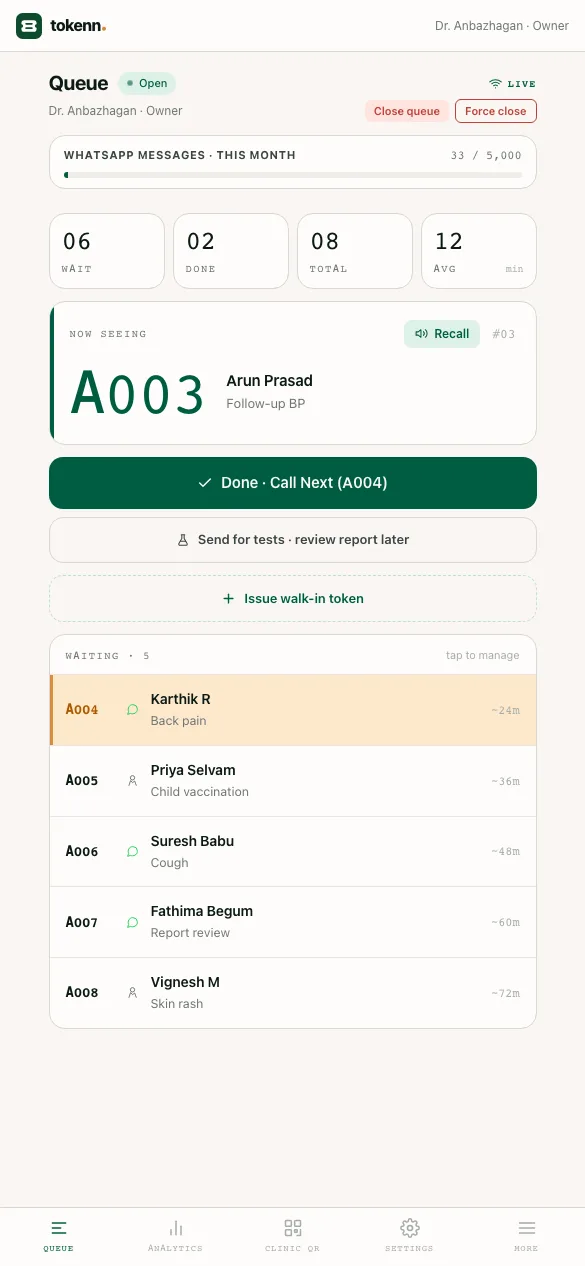
Clinic appointment software vs a walk-in clinic: where appointments break down
One long consultation pushes every later slot back and the schedule unravels by mid-morning. The desk spends the rest of the day apologising for times it never controlled. Patients booked for 11:00 who wait until 12:30 do not remember the wait; they remember the broken promise, and it is the promise that costs the clinic the patient. The trust cost is the real bill, and it is covered below.
Where tokens win
A token sets the right expectation: you are number 14, roughly a 40-minute wait. Nobody is promised an exact minute, so nobody feels cheated when a consult runs long. Walk-ins and emergencies fit naturally, because adding one to an order is trivial and adding one to a timetable is not. General physicians, with a prescription refill next to a first-visit workup, live in this variance all day.
The hybrid: a number plus a live arrival time
TOKENN keeps the token and adds the part of appointments people actually wanted: a live position, an estimated arrival time, and reminders. The patient gets "A014, about 40 minutes, arrive around 10:40" on WhatsApp, then a 2-ahead reminder when it is nearly time. If the morning runs late, the reminder simply lands later, and so does the patient. The order was never a promise that could break; the estimate is honest because it is recalculated as the queue moves.
Booking ahead works too. A patient who messages before opening gets a number, the opening time and their place in line, so the 7 AM booker knows whether to come at 9:00 or 10:30. What TOKENN does not do is sell clock-time slots. If your practice genuinely needs "Tuesday 4:15", it is a diary, not a queue, and you should say so before trialling anything.
A 20-patient morning, both ways
Twenty patients, a doctor who averages ten minutes but sometimes takes twenty-five. On appointments, the 9:30 consult that runs to 9:55 makes the 9:40, 9:50 and 10:00 patients late before the morning has started, and by 11:00 the queue in the room is the same as it would have been with no system at all. On tokens with live estimates, the same overrun moves every estimate by fifteen minutes; patients at home get their 2-ahead reminder fifteen minutes later and arrive fifteen minutes later. The room never holds more than the four or five people who are genuinely next.
Should a clinic use tokens or appointments? It depends on consult variance
Look at consult-length variance. A specialty with uniform visit lengths, such as a fixed-duration physiotherapy session or a scheduled vaccination slot, tolerates a pure appointment model, because the assumption a slot system makes is true there. A general OPD, dental practice or ENT clinic, where a two-minute review sits next to a thirty-minute procedure, is a token clinic whether it admits it or not. Most practices are in between and do best with a token queue that gives honest times.
Whichever model you run, the WhatsApp assistant only handles queue tasks. It never diagnoses, never suggests a medicine, and hands medical questions to reception; staff see every conversation and can change any token with one tap.
What patients say when you ask them
Survey patients and the answer is rarely "I want a fixed time slot." It is "I want to know how long I will actually wait, and I do not want to sit in your lobby to find out." A rigid appointment book satisfies neither once one consult overruns. A token with a live position and a 2-ahead message satisfies both. That is why clinics that move from a paper appointment book to a WhatsApp token queue rarely go back, even when the switch was driven by cost rather than conviction: the token queue was solving the problem patients actually had.
The trust cost of getting the choice wrong
Picking the wrong model is not just scheduling friction. A clinic that promises 11:15 and runs forty-five minutes behind teaches patients to distrust every time it quotes, including the accurate ones. Once patients stop believing the stated time, they arrive early just in case, which recreates the crowding the appointment system was meant to prevent. A token queue with honest, live estimates never makes a promise it cannot keep, so there is no trust to lose.
Switching without disrupting a running clinic
Clinics moving from appointments to tokens do not have to throw the diary away. They have to stop treating it as an exact-minute promise. A practical migration: keep a handful of preferred slots a day for the patients who need to plan, surgery follow-ups and first consults, but issue everyone a token regardless, walk-ins included, in one running queue. The token decides who is next; the slot is a soft preference for who gets first crack at a token that morning. Most clinics finish the switch in a day, because nothing about the physical workflow changes: the doctor still sees one patient at a time, in order. What changes is that the order lives on a phone instead of a register, and every waiting patient can check it themselves.
To decide for your own clinic, look at last month. If consults mostly ran close to their scheduled length, a light appointment structure will serve you. If a meaningful share ran well over or under, a token queue with live estimates is the better fit, and for most Indian general practice and multi-specialty OPDs that is the honest answer.
What it costs to find out
TOKENN is ₹1 per patient token, whatever the volume, with reminders and multiple departments included. Start with 150 tokens for ₹149; nothing expires. Run one real morning on tokens with live estimates and ask the patients at the desk which they preferred; that answer is worth more than either column above. Plans are on the pricing page.
Frequently asked questions
What is the difference between a token system and an appointment system?
An appointment promises a time; a token promises an order. A long consultation breaks the first promise and not the second.
Which is better for a general clinic in India?
A token queue with live estimates. General OPD consult lengths vary too much for fixed slots to hold.
Can patients still book before the clinic opens?
Yes. They get a number, the opening time and their place in line, so they know when to come.
Does TOKENN offer clock-time appointment slots?
No. It is a token queue with live arrival estimates and advance booking, not a diary of fixed times.
Which clinics should keep appointments?
Ones with genuinely uniform visit lengths, such as fixed physiotherapy sessions or scheduled vaccinations.
What happens to the token queue when the doctor runs late?
The order holds, the estimates update, and the 2-ahead reminders land later, so patients at home arrive later too.
Try TOKENN for your clinic
₹1 per patient · start with 150 tokens for ₹149 · nothing expires · no hardware · set up in 10 minutes. See pricing.
See also
Polyclinic software for multi-doctor clinics and group practices: a live queue per doctor →
Gynecology clinic queue management on WhatsApp: numbers, never names →