Queue management kiosk alternative: the same token queue on WhatsApp and a TV, without the machine
A queue kiosk is a token machine at the clinic door: the patient presses a button, a slip prints, a wall display shows the number. A kiosk alternative does the same job without the machine, issuing the token on the patient's phone before they arrive and showing the queue on a TV the clinic already owns. Kiosks in India run ₹30,000 to ₹80,000 plus an annual maintenance contract; TOKENN runs at ₹1 per patient.
What a kiosk solves, and what it cannot
A kiosk solves the moment of arrival. It hands out numbers in order and stops the crowd at the desk from arguing about who came first. That is real, and it is why clinics buy them.
What it cannot do is reach the patient before they walk in. A kiosk only works on people already standing in front of it, which means everyone still arrives at opening time and the room still fills. The wait has been organised, not shortened. The second thing it cannot do is answer "how many are ahead of me?" from home, so the phone keeps ringing.
Side by side
The comparison below uses the price ranges already published across the Indian kiosk market; the right-hand column is what TOKENN does today.
| Queue kiosk | TOKENN on WhatsApp + TV | |
|---|---|---|
| Upfront cost | ₹30,000 to ₹80,000 for a clinic-grade kiosk | ₹0; uses the TV, phone and laptop you have |
| Running cost | Annual maintenance contract, thermal paper, service calls | ₹1 per patient, WhatsApp messages included |
| Reaches the patient at home | No | Yes: token, arrive-around time, 2-ahead reminder, your-turn alert |
| "How many ahead of me?" | Look at the wall, or phone the desk | Reply "status" on WhatsApp |
| Display | Bundled proprietary board | Any Android TV or tablet, with voice announcements |
| When the printer jams | Back to shouting names | Nothing to jam |
| Walk-ins | Press the button | Reception issues a token in two taps; same queue |
| Languages | Whatever is printed on the slip | Tamil, Hindi, Tanglish, Hinglish, English and more |
| Cancellations and no-shows | Invisible | Patients cancel by message; the slot frees up |
| End-of-day data | None | Patients seen, no-shows, average wait, peak hour |
| Three-year cost | About ₹68,000 for a ₹50,000 kiosk with a ₹6,000 a year contract | About ₹13,000 at ₹1 a patient, for a dozen patients a day |
Token kiosk price in India: the three-year maths
A ₹50,000 kiosk with a typical ₹6,000 a year maintenance contract costs roughly ₹68,000 over three years, before thermal paper and the printer service call that always comes. TOKENN at ₹1 a patient is about ₹13,000 over the same three years for a clinic seeing a dozen patients a day, proportionally more for a busier one, and that figure already includes the software, the dashboard, the WhatsApp messages and the display. The gap is not the interesting part. The interesting part is that the cheaper option is the one that reaches the patient before they arrive.
Token machine price for a clinic, by class
Kiosk quotes vary by what is in the box. These are the typical ranges Indian vendors quote a small clinic; ask for the maintenance line separately, because it is rarely in the first number.
| Upfront | Running cost | What it does | |
|---|---|---|---|
| Manual ticket dispenser | ₹2,000 to ₹5,000 | Paper rolls | Hands out a number. No display, no queue, nothing for the patient at home. |
| Basic token kiosk with LED counter | ₹30,000 to ₹45,000 | Maintenance contract of ₹4,000 to ₹6,000 a year, thermal paper | Prints a slip and shows the number being served on one counter. |
| Touchscreen kiosk with bundled board and printer | ₹50,000 to ₹80,000 | ₹6,000 to ₹10,000 a year, paper, service visits | Several counters, a bigger board, sometimes a voice call. Still nothing for the patient at home. |
| TOKENN on WhatsApp and your TV | ₹0 | ₹1 per patient, WhatsApp messages included | Token by message, arrive-around time, two-ahead reminder, walk-in desk, talking display, daily numbers. |
Queue kiosk vs WhatsApp, in one paragraph
A kiosk organises the people already in your lobby. WhatsApp keeps most of them out of it until it is nearly their turn. Both give a fair order, both show a number on a screen, both take a walk-in. Only one of them can tell a patient at home to leave in twenty minutes, take a cancellation by reply, or recall someone on the same number after a blood test. That is the whole comparison; the price difference is a bonus.
A clinic token machine alternative: the display board, without the board
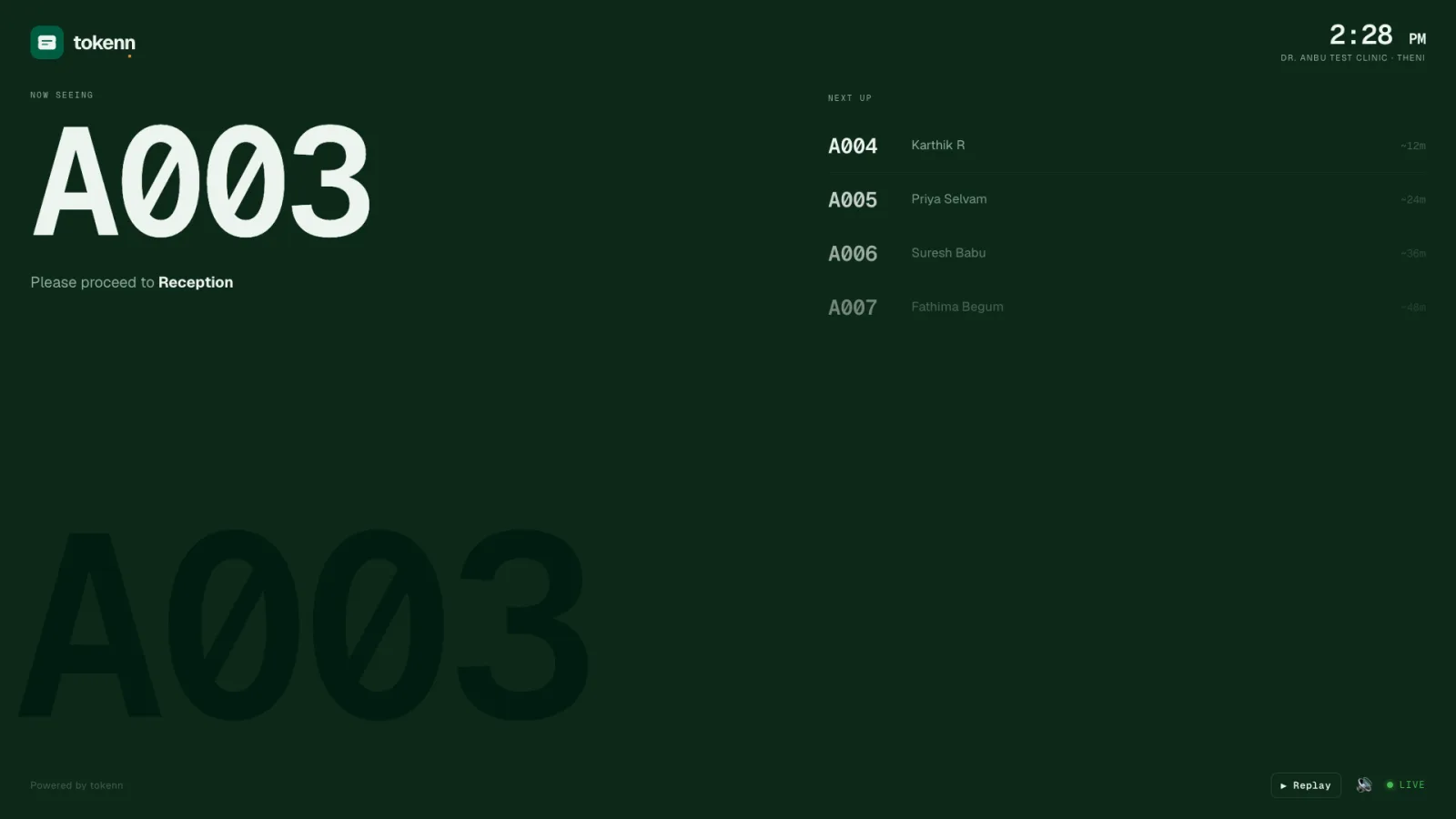
The part of a kiosk system clinics actually like is the wall display, and that part survives. TOKENN's waiting-room display runs in a browser on any Android TV or tablet, shows the token being seen and the next four, and announces each call out loud. Setting it up takes minutes, and if the TV is already on the wall the cost is zero. See the OPD queue page for how the display, the dashboard and the WhatsApp side fit together.
Walk-ins and patients without a phone
A kiosk's honest advantage is that it needs nothing from the patient. TOKENN keeps that: reception issues a walk-in token in two taps for anyone who arrives without WhatsApp or without a phone at all, and it joins the same fair queue as the remote bookings. Elderly patients do exactly what they did before. Nobody is asked to install anything, because there is no app.
The WhatsApp assistant only handles queue tasks. It never diagnoses, never suggests a medicine, and hands any medical question to reception. Every conversation is visible to your staff, and any token can be changed with one tap.
When a kiosk still makes sense
There is one real case: very high-volume settings where almost every patient is an anonymous walk-in with no relationship to the desk, such as a large diagnostic lab chain, a government hospital wing or a busy pharmacy counter. A dispense-and-forget number machine fits that flow. A clinic where the same patients return week after week, most of them with WhatsApp in their pocket, is the opposite situation: reaching them before they arrive is worth more than a nicer printed slip. For a lab that sits between the two, the diagnostic lab page covers sample-collection rushes specifically.
If you already bought a kiosk
Do not run two queues. A kiosk that prints its own numbers and a WhatsApp queue that issues its own will collide by ten o'clock. Either keep the kiosk as a walk-in-only desk and issue every number through TOKENN, or retire it and let reception issue walk-ins from the dashboard. The TV it came with can usually show the TOKENN display instead.
The fair version of this comparison also asks what happens when each one fails. A kiosk fails at the printer, the touchscreen or the paper roll, and when it does the desk goes back to shouting names until a technician comes. A WhatsApp queue fails at the internet: with the connection down, reception issues walk-in tokens from the dashboard as usual once it reconnects, the display keeps showing the last state it received, and messages queue and send when the line returns. Neither is immune. The difference is that one failure needs a service visit and the other needs the router to come back.
The maintenance burden the sales pitch leaves out
Vendors quote the hardware and the contract. They rarely mention what it takes to keep a physical machine running: the printer that jams on a Monday with the queue already forming, the touchscreen that stops responding until a technician visits, the thermal paper that runs out mid-morning because nobody restocked it. Each is a small annoyance on its own. Together they describe a machine that fails at the one moment it is needed, the busy morning rush. A queue on the patient's phone has no moving part to jam and no consumable to run out.
The one question to ask before buying either
Before signing a kiosk quote or a software subscription, ask: does this reach the patient before they physically arrive? A kiosk, by definition, cannot; the patient has to be standing in the lobby to use it. That single question filters out most wrong purchases faster than a feature-by-feature comparison. Owners who lay the two options side by side usually decide quickly, and not on price: the kiosk solves the problem the clinic already has a workaround for, the argument at the desk, and leaves untouched the one that drives complaints, not knowing when to come. What they worried about losing, a modern feel in the waiting room, turns out to run the other way. Patients read a TV showing a live queue as more current than a beige box with a slip printer.
What the alternative costs
Every token costs ₹1 and includes the 2-ahead and your-turn reminders and multiple departments. No hardware, no maintenance contract, no monthly bill. Start with 150 tokens for ₹149; nothing expires, so the comparison worth trusting is a week of your own OPD, not this table. Full plans are on the pricing page.
Frequently asked questions
What is a clinic queue kiosk alternative?
A token queue that runs on the patient's WhatsApp and a TV the clinic already owns, instead of a token-printing machine at the door.
How much does a clinic queue kiosk cost in India?
Typically ₹30,000 to ₹80,000 for a clinic-grade kiosk, plus an annual maintenance contract and thermal paper.
Do I still get a waiting-room display without a kiosk?
Yes. TOKENN's display runs on any Android TV or tablet and announces each token out loud.
What about patients who cannot use WhatsApp?
Reception issues a walk-in token in two taps. It joins the same queue and shows on the display.
When is a kiosk the better choice?
Very high-volume settings where nearly every patient is an anonymous walk-in, such as a large lab chain or a hospital wing.
Can I keep the kiosk I already have?
As a walk-in-only desk, yes, but do not run its numbers and a WhatsApp queue side by side. One queue, one set of numbers.
Try TOKENN for your clinic
₹1 per patient · start with 150 tokens for ₹149 · nothing expires · no hardware · set up in 10 minutes. See pricing.
See also
Clinic token system: a walk-in number in two taps, online token booking for the rest →
WhatsApp chatbot for clinics in Tamil, Hindi and English →
Pediatric clinic token system on WhatsApp: sick children wait at home, not in the room →