Clinic token system: a walk-in number in two taps, online token booking for the rest
A token system for clinic front desks has one job: give every patient a fair number in two taps, whether they walked in or booked on WhatsApp. Walk-in clinics are where queue management is most needed and most broken. Patients sit for hours because nobody can tell them their position. A token system that doesn't communicate position, wait time, or "your turn" is just a worse version of paper slips.
What is a clinic token system?
A clinic token system gives every patient a numbered place in the queue, issued at the desk for walk-ins or remotely on WhatsApp, then tracks the live order, shows the now-serving number on a display, and calls patients in turn. A queue number system done properly tells each patient three things: their number, their position, and roughly when to come.
Digital token system for clinics vs paper: the real difference
Paper has no memory. Once the pile is shuffled, nobody knows who came, who skipped, or who's next. Clinic token management only works when the system remembers for you: a digital queue token system stores the order, the issue time, and a patient name, and exposes that to staff on one screen and to patients on WhatsApp.
The shift isn't about going "digital" for its own sake. It's about reaching the patient outside the clinic so they don't need to physically wait for two hours just to know how long they have left.
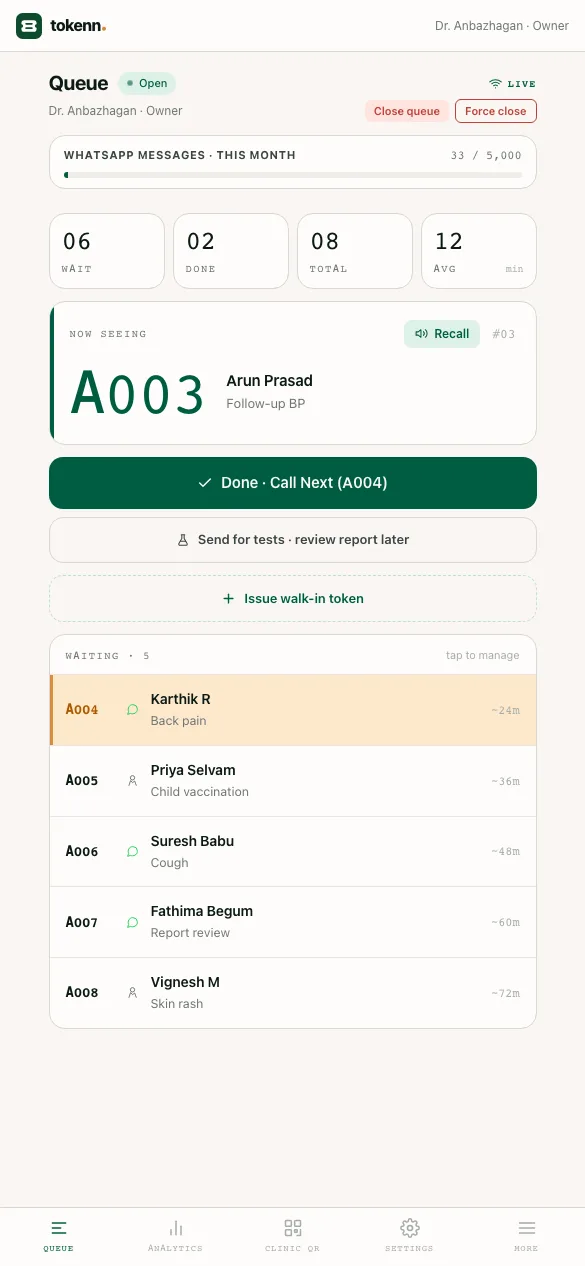
How the walk-in token system works
Reception taps "+ Walk-in", enters the patient's name and (optionally) WhatsApp number, confirms. Done. If a phone number was given, that patient gets the same 2-ahead and your-turn alerts as a patient who used doctor token booking on WhatsApp from home. If not, they wait in the room, but they at least see their number on the display.
The waiting-room screen is a queue number calling system in itself: it calls each new token out loud with a voice announcement. Staff stop being a human PA system; patients stop crowding the desk asking what number is on now.
Labs and collection centres too
The same walk-in flow covers diagnostic labs and collection centres too (sample queues, report-ready recalls) without any extra setup. The same two taps issue a token for a sample collection as for a consult; only the queue's minutes-per-patient changes.
Why clinic token management software needs to be faster than the problem it replaces
The bar for a walk-in flow is not "better than paper": it is "as fast as paper, but with memory." A paper slip took the receptionist two seconds to tear off and hand over; if the digital replacement takes thirty seconds of typing and dropdown selection, staff will quietly go back to paper the first busy morning. TOKENN's walk-in issue is deliberately two taps: name, optional phone, confirm. Anything slower than the old habit does not get adopted, no matter how many features it adds.
Mixing walk-ins with WhatsApp bookings fairly
The hardest part of a walk-in system is not issuing the token: it is making sure walk-ins and QR-booked patients sit in one honest, shared order rather than two separate lines that patients suspect are being gamed. TOKENN keeps a single running queue: whoever's token number comes up next is served next, regardless of whether they booked from home an hour ago or walked in five minutes ago, the same single-queue rule an OPD queue management system runs at larger scale. That single fairness rule is what keeps the system from becoming a new source of waiting-room disputes. A walk-in who arrives at 9:40 takes the number after the last WhatsApp booking made before 9:40, not a number at the back of the day, and the display shows both kinds in one sequence so nobody in the room can tell which is which.
A patient token system for the elderly patient this was built for
A walk-in token system is not a fallback for patients who "haven't caught up with technology": it is the primary interface for a meaningful share of every clinic's patients, and treating it as a first-class flow rather than an afterthought shows. An elderly patient without a smartphone gets a token in two taps at the desk, sees their number called out loud on the display, and never has to understand what WhatsApp is to get exactly the same fair treatment as a patient who booked digitally from home.
What the display board adds beyond the token itself
Issuing a token solves half the problem; showing it solves the other half. The waiting-room display announces each new "now serving" number out loud, so a patient does not need to stare at a screen or strain to hear a name called across a noisy room. This matters most for exactly the walk-in patients least likely to be checking a phone: they simply listen for their number, the same habit they already have from banks and government offices, except this one is free to set up on a TV the clinic already owns.
Setting this up in practice
A clinic adopting a walk-in token system needs no new hardware beyond what it likely already has: a phone or tablet at reception for issuing tokens, and any spare TV or tablet for the display. There is no kiosk to buy, no thermal printer to keep stocked, and no separate walk-in "mode" to remember to switch on: walk-ins are simply one more way a token enters the same queue everyone else is in. Most clinics run the first morning with the desk issuing every number through the dashboard while the paper pad stays in the drawer as a fallback nobody reaches for; by the second morning the pad is gone, because the dashboard is the thing that stops the phone ringing.
What happens if a walk-in patient later wants WhatsApp reminders
A patient who initially walked in without giving a phone number isn't locked out of reminders for the rest of that visit. If they later decide to share a number, perhaps after realising they'll be waiting a while, reception adds it to their existing token in a few taps, and they start receiving the same 2-ahead and your-turn alerts as anyone who booked by WhatsApp from the start. Nothing about the walk-in path is a one-way, lesser-service door.
Why "walk-in" does not mean "second-class"
Some queue tools quietly treat walk-in patients as an afterthought, a secondary list processed after digital bookings, or a separate counter that runs slower than the "real" system. TOKENN's design deliberately avoids that: a walk-in token and a WhatsApp-booked token look identical once issued, sit in the identical queue, and are served in the identical fair order. The only difference is which door the patient came in through, and that difference has no bearing on how quickly they are seen.
Handling a sudden rush of walk-ins
Busy mornings sometimes bring a cluster of five or six walk-ins in quick succession: a school-holiday pediatric rush, a weather-related spike in respiratory complaints, a nearby event ending. The two-tap issue flow is designed to hold up under exactly this pressure: each token still takes seconds regardless of how many reception is processing back to back, and the live queue recalculates every wait estimate the moment each new token joins, so nobody's number is wrong even during the rush.
Frequently asked questions
How long does it take to issue a walk-in token?
Two taps and an optional name + phone: under five seconds at the desk.
Can a walk-in patient share a phone with a family member?
Yes. If a number is already on another token that day, reception just confirms it's a family member and the token is issued: the duplicate check is a prompt, not a block.
Will the display board still work without a phone number?
Yes. The display shows the now-serving token regardless; only the WhatsApp reminders need a phone.
Do walk-ins and WhatsApp bookings sit in the same queue?
Yes. One running queue in true token order. There is no separate walk-in line that could be seen as unfair.
Does this work for elderly patients uncomfortable with smartphones?
Yes. The walk-in flow is a first-class path, not a fallback. Reception issues the token; the patient simply listens for their number on the display.
What hardware do we need beyond what the clinic already has?
Usually none. A phone or tablet at reception plus any spare TV or tablet for the display is enough: no kiosk or dedicated hardware.
Try TOKENN for your clinic
₹1 per patient · start with 150 tokens for ₹149 · nothing expires · no hardware · set up in 10 minutes. See pricing.
See also
WhatsApp chatbot for clinics in Tamil, Hindi and English →
Queue management kiosk alternative: the same token queue on WhatsApp and a TV, without the machine →
Pediatric clinic token system on WhatsApp: sick children wait at home, not in the room →