WhatsApp token booking for clinics: a queue number by message, no app
WhatsApp token booking is a way for a patient to get a clinic queue number by sending a WhatsApp message: no app to install, no website login, no call to reception. It is online token booking on the app patients already have. TOKENN reads the message, issues the next token, tells the patient roughly when to arrive, and messages again when two patients are ahead and when it is their turn.
How WhatsApp token booking works, step by step
The patient scans the clinic QR at the desk, on the door, or on your Google listing. WhatsApp opens on the clinic's number with a message already typed. They tap send. If they prefer, they skip the QR and simply message the number in their own words: "token", "Doctor irukkanga?", "अभी नंबर मिलेगा?". The assistant understands all of these.
TOKENN issues the next number in the queue and replies with the token, the estimated wait, and an "arrive around" time. The receptionist sees the token appear on the dashboard the same second, marked with a WhatsApp icon so staff know it came in remotely.
While the patient waits at home, the queue keeps moving. When two patients are ahead of them, they get the 2-ahead reminder. When reception calls their number, they get a your-turn message and the waiting-room display announces it. They walk in, they are seen. That is the whole flow.
What the patient sees
The first reply is the one that matters, because it sets expectations. It reads, in full: "Your token number is A007 🎫. Your estimated wait is 25 minutes. Arrive around 10:30 AM. Please go to reception when your number is called." Then a second line tells them what else they can do: reply "status" for their turn, "cancel" to cancel, or ask about clinic timings and location.
A "status" reply answers with their token, how many patients are ahead, the wait in minutes, and which number is being served now. Nothing to interpret, nothing to calculate. The patient can ask as often as they like; the receptionist never picks up a phone for it.
Everything arrives in the language the patient used. A Tamil message gets a Tamil reply. A Hinglish message gets a Hinglish reply. See the clinic chatbot page for what that looks like in practice.
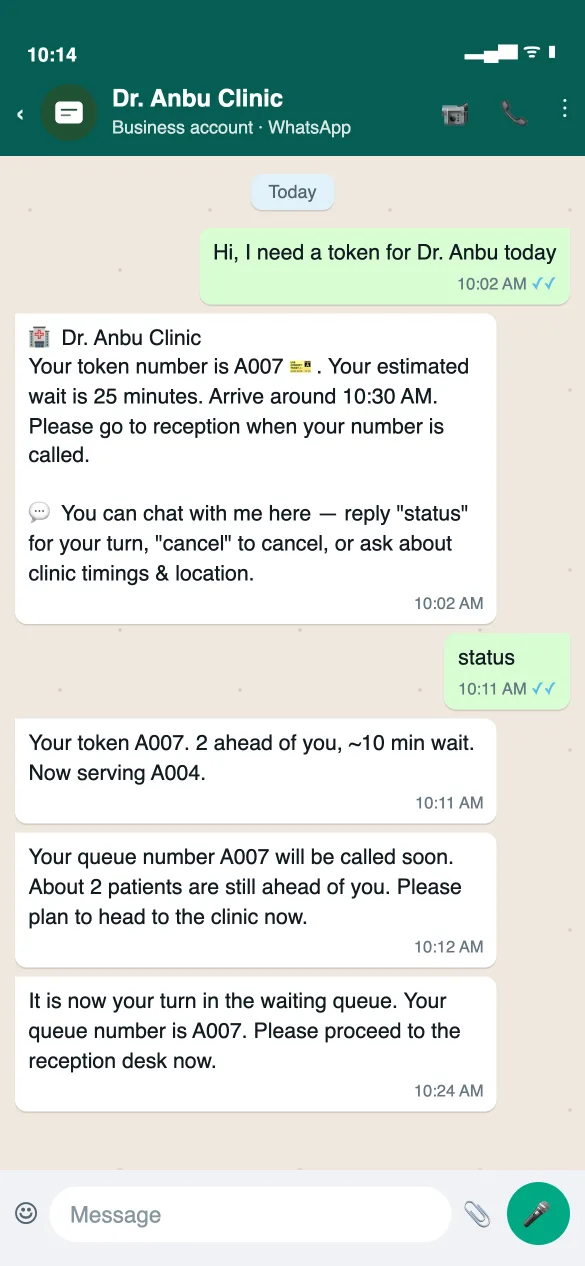
Book a doctor token on WhatsApp before the clinic opens
A lot of booking happens at 7 AM for a 9 AM OPD. If you allow advance booking, a patient who messages before opening still gets a number, and the reply changes to fit: it names the opening time, their place in line, and when to arrive. It does not quote a live wait that would be meaningless an hour before the doors open.
You choose how far ahead booking opens. Message earlier than that and the assistant says when booking starts and asks the patient to message again then. Outside clinic days it says the clinic is closed and, if it knows, when it reopens. No token is ever issued into a queue that does not exist.
What the receptionist sees
The dashboard is one screen: who is being seen, who is next, and everyone waiting with their estimated time. WhatsApp bookings and walk-ins sit in the same list. For a patient who arrives without a phone or without WhatsApp, reception taps "Issue walk-in token" and the number joins the same fair queue in two taps. Nobody is pushed to the back for not having the app, because there is no app.
An emergency walk-in gets "Call now" and is seen next; everyone else shifts by one and their wait estimates update live. A patient sent for a blood test is parked in an awaiting-report lane and recalled on the same token when they return. These are the two things paper tokens cannot do without an argument at the desk.
Duplicates, cancellations and the daily limit
One phone number gets one open token per day. If a patient messages again, the assistant reminds them of the token they already have instead of issuing a second one. When a family genuinely shares a phone, reception can override this from the dashboard.
A patient who cannot make it replies "cancel" and the token is released. That is the quiet reason no-shows drop: cancelling by message is easier than not turning up. Each plan carries a daily token limit (50, 200 or 500); if it is reached, the assistant asks the patient to visit reception rather than promising a number the clinic cannot serve.
The boundary: what the assistant will not do
The assistant books, checks status, cancels, and answers questions about timings and location. It never diagnoses, never suggests a medicine, and never answers a medical question. If a message is unclear, it asks one short clarifying question; if the request is outside its job, it points the patient to reception. If a patient mentions chest pain, breathing trouble or an accident while booking, the token is issued and the urgency is flagged to staff on the dashboard.
Voice notes get a request to type instead. Every conversation is visible to your staff, and any token can be overridden with one tap.
A WhatsApp booking system for clinics on the official API, on your own number
TOKENN runs on Meta's WhatsApp Cloud API, not a personal WhatsApp wrapped in a dashboard. That means your clinic's verified business number, no risk of a ban for automation, and template messages delivered even when the patient has not messaged in the last 24 hours. The setup guide walks through Meta's side; if you already have a WhatsApp Business account it takes about ten minutes, and if you do not, we do the Meta setup with you on a call.
Messages are included in every plan up to its cap; beyond it they are ₹0.20 each, passed through at near cost.
QR code token booking at the clinic door: why the QR matters more than it looks
The QR removes the one piece of friction WhatsApp booking still has: typing or saving a phone number correctly. A patient who scans it at the door, on the Google listing or on a printed card has WhatsApp open with the message already filled in, nothing to mistype and no contact to save. For an elderly patient on a small keyboard, that is the difference between finishing the booking and phoning instead.
WhatsApp appointment booking for clinics, versus a website or an app
A booking site or app asks the patient to find it, install it, create an account, verify a number and then book: five steps. WhatsApp is one step, send a message. Every extra step loses the patients who give up and call, and the call is the cost the clinic is trying to remove. The clinic queue app comparison has the two side by side.
Clinics notice the phone first. Calls for "can I get a token" and "how long is the wait" drop within days, because both are answered inside the thread the patient booked in, and reception's morning goes to the patients at the desk instead.
What WhatsApp token booking costs
There are no plans: ₹1 per patient token, and that includes the 2-ahead and your-turn reminders and multiple departments, so a solo GP seeing 30 patients a day pays about ₹900 a month. Start with 150 tokens for ₹149; nothing expires, so the first real morning costs nothing. Full details are on the pricing page.
Token booking is the front door to the rest of the system: the live OPD queue, the walk-in token desk, the waiting-room display, and the specialty flows such as dental clinics. It also works alongside whatever EMR or billing software you already use, with no integration.
Online token booking without an app: a doctor token on WhatsApp
Online token booking is what most people who search for a doctor token booking app or a hospital token booking app actually want: to get the token before they leave home. They do not want another app. WhatsApp token booking gives the same outcome on the app they already open thirty times a day: message the clinic, receive the token and a live wait, get a nudge when two patients are ahead, and walk in when it is their turn.
It also covers what a WhatsApp appointment booking system or a WhatsApp appointment bot promises, with one honest difference. A token is a place in today's line, not a named time slot; the live wait and the two-ahead reminder are what make it feel like an appointment. Clinics that need named slots for procedures can read the token versus appointment comparison.
Frequently asked questions
Is this a doctor token booking app?
It does what the app would do, without the install: the patient messages the clinic on WhatsApp and gets a token, a live wait, a two-ahead reminder and a your-turn alert. Reception sees every booking on one dashboard.
What does the patient receive after booking?
The token number, an estimated wait, an arrive-around time, then a reminder when two patients are ahead and a your-turn message when called.
Can patients book before the clinic opens?
Yes, if you allow advance booking. The reply then gives the opening time and their place in line instead of a live wait.
What if a patient does not have WhatsApp?
Reception issues a walk-in token in two taps. It joins the same queue as WhatsApp bookings and shows on the display.
Can a patient cancel by WhatsApp?
Yes. Replying "cancel" releases the token immediately, which is why no-shows fall.
Will the assistant answer medical questions?
No. It books, checks status and cancels. Medical questions are pointed to reception, and urgent words are flagged to staff.
Try TOKENN for your clinic
₹1 per patient · start with 150 tokens for ₹149 · nothing expires · no hardware · set up in 10 minutes. See pricing.
See also
OPD queue management system with WhatsApp token booking →
Paper token vs digital token system for clinics: what a small clinic actually gains →
Dental clinic queue management on WhatsApp: one queue per chair →