Clinic queue app vs WhatsApp token system: which one do patients actually use?
A clinic queue app is a patient-side mobile app that shows a token number and a queue position; a WhatsApp token system delivers the same token, position and reminders inside WhatsApp, with nothing to install. Most queue vendors in India sell the app. It demos beautifully. Then reality arrives: the 55-year-old with 40 MB of free storage, the one-time visitor who will never install an app for a single consultation, the elderly patient whose grandson set up their phone. A clinic queue app only works for the patients who install it. A WhatsApp token system works for everyone, because the app is already on their phone.
The download problem no patient queue app vendor mentions
App-based queue systems assume a patient will find your app on the Play Store, install it, sign up with an OTP, and allow notifications, all before their first visit. For a clinic whose patients visit twice a year, that funnel loses most people at step one, and the ones who make it through often delete the app the week after, so the next visit starts from zero again.
WhatsApp inverts the funnel. There is nothing to install and no account to create: the patient scans a QR at your desk or on your board, sends one message, and has a token. The same thread carries their reminders, their queue position, and their next visit six months later. The best app is the one nobody has to install.
Side by side
The left column is what a typical patient queue app asks of the patient and the clinic. The right column is what TOKENN does today.
| Clinic queue app | TOKENN on WhatsApp | |
|---|---|---|
| What the patient installs | Your app, from the Play Store or App Store | Nothing; WhatsApp is already there |
| Sign-up | Account, OTP, profile | None; the phone number is the identity |
| First-time or one-off patient | Rarely installs for one visit | Scans the QR, sends one message |
| Elderly patients | Depends on a family member setting it up | Message in their own language, or take a walk-in token at the desk |
| Reminders | Push notifications, if permission was granted and the app is still installed | A WhatsApp message: 2-ahead reminder, then your-turn |
| Language | Usually English menus | Tamil, Hindi, Telugu, Tanglish, Hinglish, English and more, in the patient's own words |
| Cancelling | Find the screen in the app | Reply "cancel" |
| Staff side | A dashboard | A dashboard in any browser, plus walk-in tokens in two taps |
| Waiting-room display | Often a bundled kiosk or board | Any Android TV or tablet, with voice announcements |
| Updates and app-store maintenance | Yours to manage, both stores, every OS release | None; WhatsApp is Meta's problem |
| Cost | Licence plus, sometimes, per-patient fees | ₹1 per patient, WhatsApp messages included |
What a queue app for clinics does that WhatsApp also does
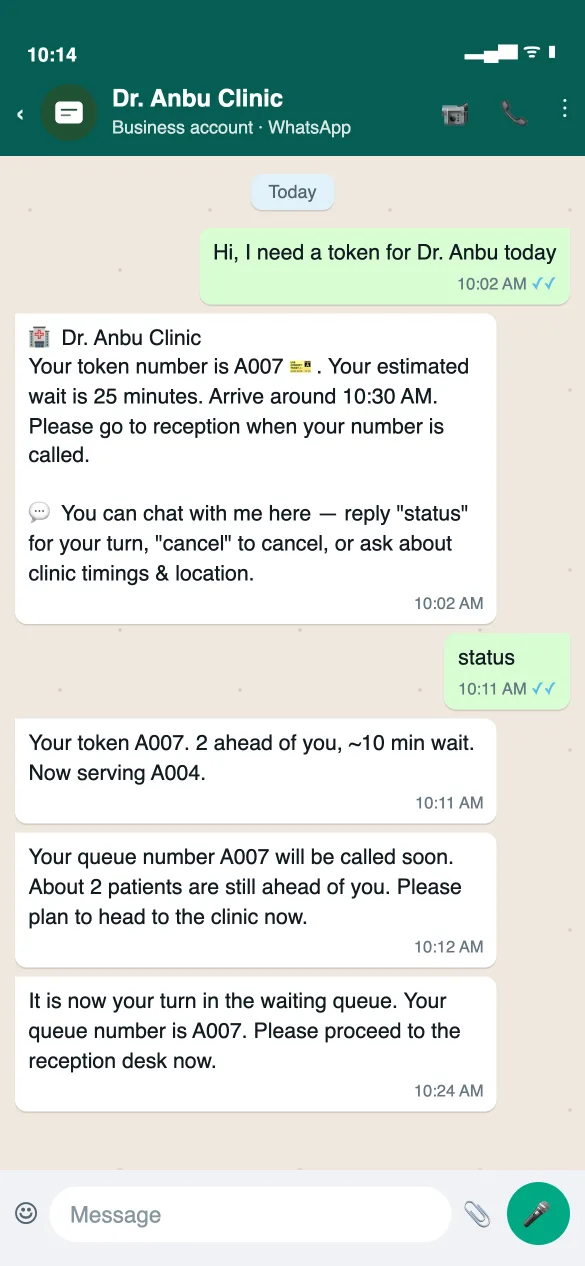
Everything patients actually need from a queue app happens in the WhatsApp thread: book a token, see the current position, get a reminder when two patients are ahead, get called when it is their turn, cancel if plans change. TOKENN's assistant handles all of it in every major Indian language, which very few patient apps even attempt. The full patient flow is on the WhatsApp token booking page.
The parts of an app-based system that are genuinely useful, the staff dashboard and the live token display with voice on the waiting-room TV, stay. Those are for your clinic, where an installed tool makes sense. It is only the patient-side app that solves the vendor's problem instead of yours.
A doctor queue app only works if its reminder arrives
A queue app is only useful if its reminder arrives. That needs the app still installed, notification permission granted, battery optimisation not killing it in the background, and the patient noticing a push among forty others. Each of those fails often enough that a clinic cannot rely on the reminder, which means it cannot rely on the patient arriving on time, which is the whole point.
A WhatsApp message has none of those dependencies. It is delivered through Meta's official Cloud API as an approved template, it lands in the thread the patient already reads, and it stays there. The 2-ahead reminder is the single feature that empties a waiting room, and it only works on a channel patients actually open.
What the clinic gives up by not having an app
Honestly: a logo on the patient's home screen, and a place to put features later, such as records, reports or payments. If those are on your roadmap, you are describing a patient portal, and TOKENN is not one. It is the queue. It runs alongside whatever EMR or billing software you use, with no integration, and it will not become your records system.
What you do not give up is anything the queue needs. Reception issues walk-in tokens in two taps, an emergency gets "Call now", a patient sent for tests is parked and recalled on the same token, and the day's numbers, patients seen, no-shows, average wait, are on the dashboard every evening.
Where a clinic queue app in India still fits
If you run a large hospital where patients have long-term treatment plans, an app with records, reports and payments attached can earn its install. That is a different product, a patient portal, not a queue tool. For the daily OPD queue itself, coverage beats features: an OPD queue management system is only as good as the share of patients it actually reaches, and a pediatric clinic, where the parent is the one messaging, shows the gap most clearly.
A clinic booking system that is not a booking app
Most clinics looking for a clinic booking system picture a product: a portal patients log into, or an app they install, with slots on a calendar. That shape is borrowed from restaurants and salons, where the booking is the whole transaction. A clinic is not that. The patient does not want a slot at 11:40, they want to not sit in a room for two hours.
Take away the interface and a booking system is doing three jobs: accepting the request, holding the order, and telling the patient when to come. WhatsApp does all three in a thread the patient already has open, which is why adoption is a non-issue: there is no login to forget and no install to abandon. Reception sees the same live list either way.
The one thing this shape gives up is a calendar of named times, which matters if your clinic genuinely runs to fixed appointments. That trade is worked through in token system vs appointment system.
The boundary, whichever you choose
There is a line the assistant does not cross: it books, checks status and cancels, and it sends anything clinical to a human. It will not read a symptom and offer an opinion. That constraint is worth weighing when you compare it against an app you would own, because an app can be built to do more, and whether it should is a question a queue vendor is not the right person to answer. Every conversation is visible to your staff, and any token can be changed with one tap.
The switching cost is close to zero
Moving from a queue app, or from paper, to a WhatsApp token system migrates no data, because there is none to migrate. Print the QR, put it on the desk, and the next patient who scans it is in the queue. With a WhatsApp Business account the setup takes about ten minutes, so the first WhatsApp morning can be tomorrow, at ₹1 per patient with no hardware and no patient-app maintenance ever again. If the real comparison in your clinic is with slips rather than an app, start with paper tokens vs a WhatsApp token system.
Frequently asked questions
Do patients need to download anything at all?
No. Booking, reminders and queue position all happen inside WhatsApp, which is already on about 98% of Indian smartphones.
What about patients without WhatsApp or a smartphone?
Reception issues them a walk-in token in two taps; they join the same fair queue and follow it on the waiting-room display.
Can TOKENN show tokens on our waiting-room TV like a queue app kiosk?
Yes. The display board runs in any TV browser and calls tokens out loud with voice announcements. No kiosk hardware.
Do reminders work if the patient has not messaged recently?
Yes. The 2-ahead and your-turn reminders are sent as approved WhatsApp templates, so they arrive even outside the 24-hour messaging window.
We already bought a queue app. Can we run TOKENN alongside it?
Yes. Run TOKENN for WhatsApp bookings while the old system handles walk-ins, then consolidate once you see which one patients use. Do not let both issue numbers for the same queue.
Is a clinic queue app or a WhatsApp token system cheaper?
TOKENN is ₹1 per patient with no hardware and no app-store maintenance. Queue apps vary; ask whether the price includes per-patient fees and who maintains the app across OS updates.
Try TOKENN for your clinic
₹1 per patient · start with 150 tokens for ₹149 · nothing expires · no hardware · set up in 10 minutes. See pricing.
See also
WhatsApp chatbot for clinics in Tamil, Hindi and English →
Queue management kiosk alternative: the same token queue on WhatsApp and a TV, without the machine →
Diabetes clinic queue management on WhatsApp: the quarterly review without the morning wait →