Paper token vs digital token system for clinics: what a small clinic actually gains
A paper token system is a numbered slip handed out at reception. A digital token system gives the patient the same number on their phone and keeps a live queue behind it. The slip is free and needs no setup, which is why most Indian clinics still use it. Its costs sit elsewhere: in the phone calls, the crowded room, and the patients who quietly leave.
Why replace paper tokens in a clinic: where the slip actually costs you
A paper token answers one question, "what is my number?", and leaves every other question to the receptionist. "How many are ahead of me?" "Should I come now?" "Is the doctor in yet?" Each one is a phone call or a walk up to the desk, and between nine and eleven a typical OPD takes dozens of them. The receptionist is answering the same question in a loop while the patient in front of her waits.
The second cost is the room. A slip does not tell anyone when to arrive, so everyone arrives at opening time, just in case. Twenty-five people in a room built for eight is not a scheduling problem; it is a paper problem. The third cost is invisible: the patient who looked at that room and went to the clinic down the road. Paper leaves no record that they were ever there.
Side by side
The comparison below is for a single-doctor clinic. The right-hand column is what TOKENN does today, not a roadmap.
| Paper token | TOKENN on WhatsApp | |
|---|---|---|
| Getting a number | Come to the desk, take a slip | Scan a QR or message; or take a walk-in token at the desk |
| Knowing when to come | Guess, or arrive at opening | An arrive-around time, then a message when two patients are ahead |
| "What number is on now?" | Phone the desk, or look at the wall | Reply "status"; the wall display shows it too |
| Cancelling | Usually nobody tells you | Reply "cancel"; the slot frees up |
| Walk-ins and elderly patients | The slip | A walk-in token in two taps; same queue, no app |
| Emergencies | An argument at the desk | "Call now"; everyone else shifts by one and their estimates update |
| Back from the lab | A new slip, or a queue-jump | Parked in an awaiting-report lane, recalled on the same token |
| End of day | A pile of slips | Patients seen, no-shows, average wait, peak hour |
| Languages | Whatever the receptionist speaks | Tamil, Hindi, Tanglish, Hinglish, English and more, automatically |
| Cost | ₹0 | ₹1 per patient; no hardware |
| Setup | None | About ten minutes with a WhatsApp Business account; a TV is optional |
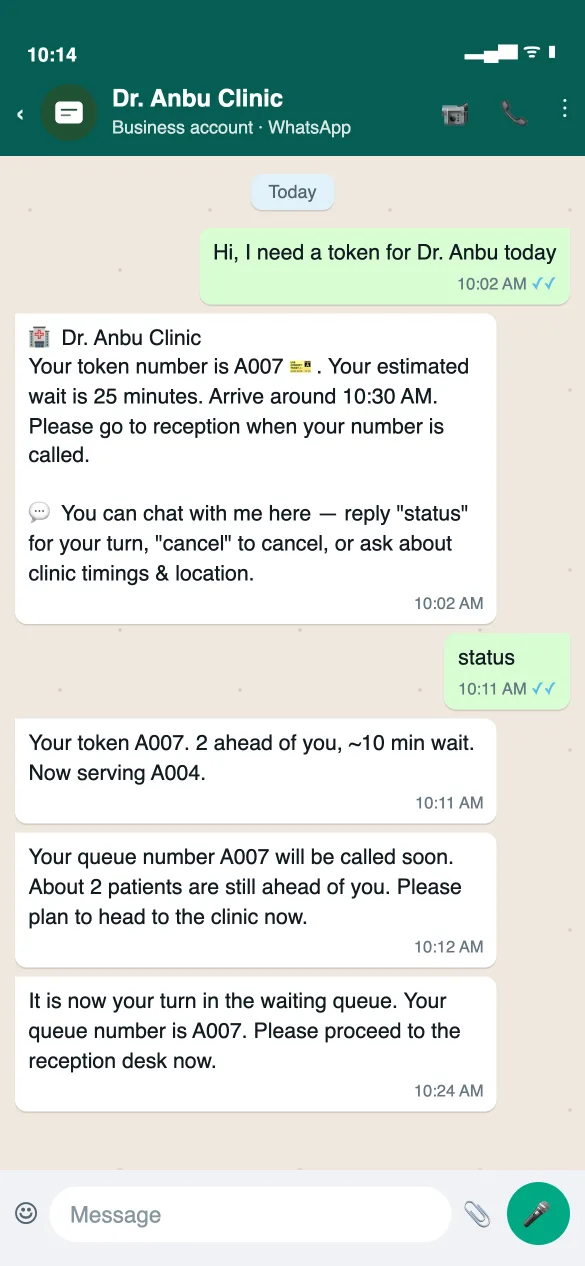
"We already use paper tokens": the objection, answered
You keep them. A patient who walks in and wants a number gets one from reception in two taps; it is the same fair queue, and the number shows on the display like everyone else's. The doctor's day does not change at all. What changes is that the patients who would rather not sit in the room now have a way to wait somewhere else, and the receptionist stops being the clinic's status hotline.
Nothing about the medical side moves. Your EMR, your billing, your prescription pad stay exactly where they are. TOKENN is only the queue. There is no integration to do because the queue and the records never need to talk.
The receptionist's morning with manual tokens, costed
Count one morning. A single-doctor OPD that sees forty patients between nine and one takes, in most clinics we have watched, thirty to fifty status questions in that window: at the desk, on the phone, or from a patient half-standing in the doorway. At a minute each, that is most of an hour of the receptionist's morning spent saying a number out loud. The same forty patients arrive in the first ninety minutes because a slip gives them no reason to come later, so the room holds twenty-five people for a doctor who sees eight an hour.
Then the costs nobody writes down. The three patients who did not come, whom nobody noticed until the end of the day because a slip cannot be a no-show. The two who looked at the room and left. The evening you cannot compare with last week, because the slips went in the bin. None of this appears on a bill, which is why paper feels free, and why the clinic that switches usually says the first thing it noticed was the phone going quiet.
Digital token system vs manual tokens: what the slip can never do
A manual token is fair and instant and needs no setup, and those are real virtues that a digital system has to keep, which is why the walk-in desk is half of TOKENN rather than an afterthought. What the slip cannot do is reach the patient before they arrive. It cannot tell them to come at 10:40 instead of 9:00, cannot message them when two people are ahead, cannot take a cancellation, and cannot recall a patient on the same number after a blood test.
A digital token can do all of that because the number lives on the patient's phone and in a live queue, not on a piece of paper in their pocket. Everything else, the order, the fairness, the desk issuing numbers to anyone who asks, stays exactly as it was. The comparison is not paper versus software. It is a number that stays in the room versus a number that travels with the patient.
What changes in the first week
Three things, in this order. The phone goes quiet for "what number is on now?", because patients ask the assistant instead. The waiting room is noticeably thinner at half past nine, because the 2-ahead reminder lets people wait at home. And cancellations start arriving as messages, so a released slot goes to the next patient instead of sitting empty while the doctor waits for someone who is not coming.
The dashboard also starts recording what the day actually looked like. Most clinics have never seen their real peak hour, because a stack of slips does not keep one.
What does not change
The doctor still sees patients in order. Reception still greets people and still issues numbers to anyone who asks. The waiting-room display is a TV you already own, set up in minutes, and it is optional. Patients who never touch WhatsApp are not disadvantaged; they simply do what they did before. The system is designed so that the clinic can adopt it one patient at a time.
The WhatsApp assistant only handles the queue. It never diagnoses, never suggests a medicine, and hands any medical question to reception; every conversation is visible to your staff, and any token can be changed with one tap. A paper slip never gave medical advice either, and neither does this.
The cost, honestly
Paper is ₹0. TOKENN is ₹1 per patient token, all in, with the reminders, the display and multiple departments in it. There is no kiosk, no annual maintenance contract and no monthly bill. Start with 150 tokens for ₹149; nothing expires, so the honest comparison is a real week of your own OPD, not this page. Full plans are on the pricing page.
If you are also weighing a hardware token kiosk, the kiosk comparison covers what those cost and why a TV does the same job.
When paper is still the right answer
A clinic seeing ten or fifteen patients a day with an empty waiting room does not have a queue problem, and a slip is fine. A desk with no reliable internet cannot run a live queue. A patient base that does not use WhatsApp at all is rare in India today, but if that is yours, the walk-in desk is the whole product and the WhatsApp side will sit idle. TOKENN earns its ₹149 in the clinic where the phone rings all morning and the room is full by nine; for the OPD and the busy dental practice, that is most days.
Frequently asked questions
Do we have to stop using paper tokens?
No. Reception issues a walk-in token in two taps for anyone who wants a number at the desk. It joins the same queue as WhatsApp bookings.
What is the main difference between a paper token and a digital token?
A paper slip gives a number. A digital token gives the number plus a live position, an arrive-around time, reminders and a way to cancel, all on the patient's phone.
Does a digital token system need hardware?
No. Staff use a phone or laptop; the waiting-room display is any TV or tablet you already own, and it is optional.
What about elderly patients who do not use WhatsApp?
They walk in and get a token from reception, exactly as before. They are not pushed to the back.
Does it change how the doctor works?
No. Patients are still seen in order. Only the waiting moves out of the room.
How much does it cost compared with paper?
Paper is free. TOKENN is ₹1 per patient with no hardware, and the first 150 tokens are ₹149.
Try TOKENN for your clinic
₹1 per patient · start with 150 tokens for ₹149 · nothing expires · no hardware · set up in 10 minutes. See pricing.
See also
OPD queue management system with WhatsApp token booking →
WhatsApp token booking for clinics: a queue number by message, no app →
Dental clinic queue management on WhatsApp: one queue per chair →