Radiology centre queue management on WhatsApp: one queue per machine, not one line
Radiology centre queue management fails the moment an X-ray and an MRI share one line. Radiology and imaging centres operate on a fundamentally different rhythm from a blood-collection lab. Scans are slot-based, equipment-bound, and 15–45 minutes long: you can't just keep walking patients in. The queue tool has to model the actual constraint: machine time.
Why an imaging centre patient queue cannot be one generic line
A diagnostic lab queue assumes a fast, parallel-capacity service (multiple phlebotomists, short collection time). An imaging centre is the opposite: one CT machine, scans are 20+ minutes, and a single case running long pushes everyone behind it.
TOKENN models each modality as its own queue with its own realistic minutes-per-patient, so the X-ray line and the MRI line generate their own honest wait estimates instead of sharing one meaningless average. Patients get a token on WhatsApp, watch their position, and get a reminder when they are two ahead, so they are not all sitting in reception from 7 AM.
Patients who are waiting on a report, not a machine
Scans take longer to report than blood tests, often a full working day for an MRI report. A patient who has had their scan but still needs the radiologist's read should not be occupying a live queue position as though they were waiting for a machine. Reception parks their token in the awaiting-report lane, and brings it back into the queue as a quick review rather than a fresh booking when the read is done. The report itself is delivered however your centre already delivers reports: TOKENN stores no scan images and no reports.
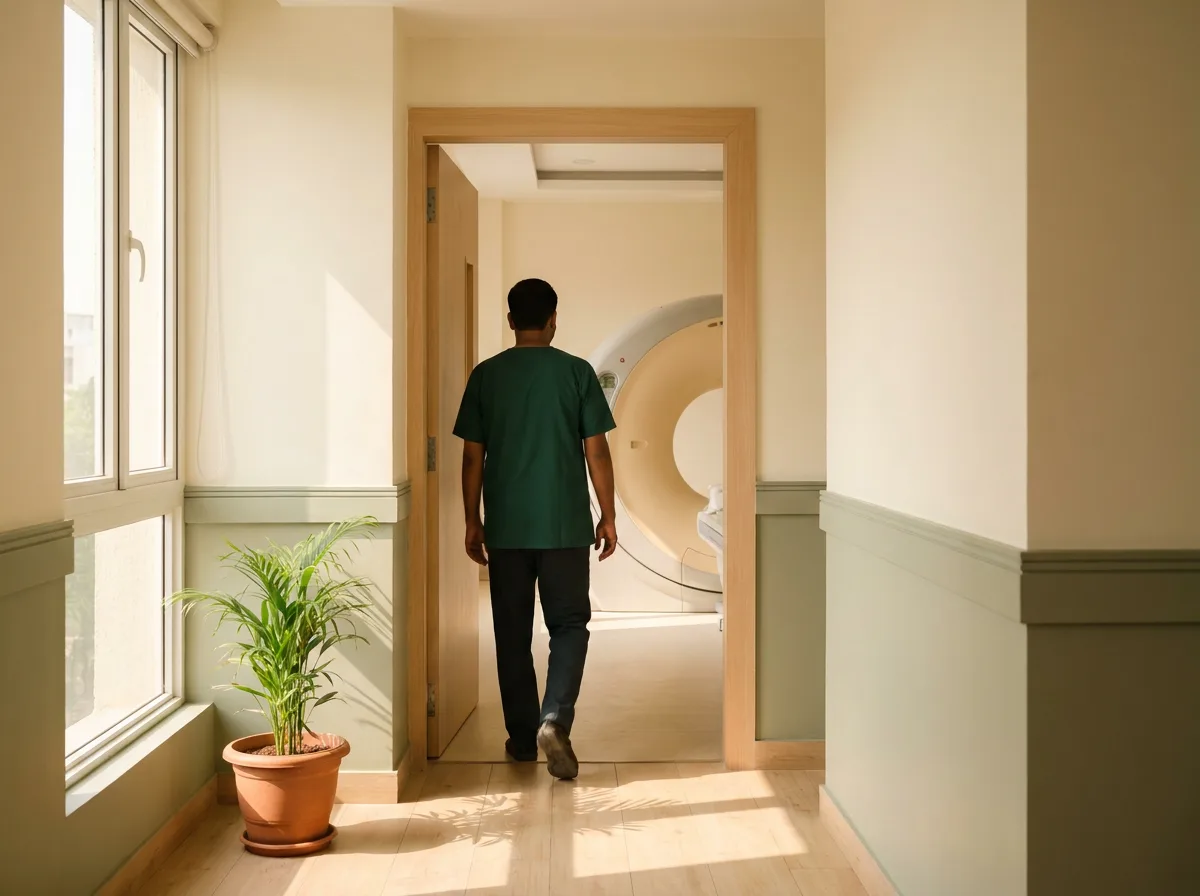
A radiology appointment system in India for patients referred from a dozen clinics
A referral tells the patient which scan to have and almost nothing about the centre doing it, so the questions land on your counter instead: is a doctor's requisition needed, how long does the machine take, does the report come the same evening. The assistant answers the practical half in the patient's own language and issues a token for the right modality; anything about the scan itself goes to your staff. Which clinic sent them can be noted in the visit reason at intake, so the day's list shows it without anyone keeping a separate register.
Emergency and urgent scan requests
A trauma case or a suspected stroke needing an immediate CT cannot wait behind a full slate of routine scheduled scans. TOKENN's priority override lets staff insert an urgent scan ahead of the queue with one tap, and every token behind it shifts back by one, with the live queue on each patient's phone and the waiting-room display both reflecting the change immediately rather than leaving people to discover the delay by sitting through it.
Contrast and fasting prep, and where TOKENN stops
A CT with contrast or an abdominal ultrasound typically requires fasting for several hours beforehand, and a patient who ate breakfast by mistake means a wasted machine slot that cannot be filled on short notice. Getting prep instructions to patients in advance is real work, and TOKENN does not do it: it sends no scheduled messages ahead of the visit, only the three tied to the day's queue. What it does prevent is the second failure mode: a correctly-fasting patient sitting in reception for three hours because nobody could tell them when their turn would come.
A scan centre token system for walk-in X-rays alongside CT and MRI
Not every imaging request arrives the same way: a suspected fracture or a same-day chest X-ray needs to be accommodated without stalling a machine already running a long list. Because each modality is its own queue with its own pace, X-ray can run a fast walk-in rhythm while CT and MRI move at theirs, with reception managing all of them from one dashboard and each queue producing its own accurate wait estimate.
Why per-machine queues matter more than a single clinic line
A single shared queue treats every token as an interchangeable "next patient", fine for a consult room where the doctor absorbs some variance, wrong for an imaging centre where each machine runs one scan at a time for a very different duration. A twenty-minute MRI and a four-minute X-ray averaged into one wait estimate produce a number that is wrong for both. Giving each modality its own queue and its own minutes-per-patient is what makes the estimate a patient sees worth trusting.
Coordinating radiologist reporting turnaround with patient expectations
Different scan types carry genuinely different reporting turnaround times, a plain X-ray might be reported within the hour, while a complex MRI with contrast might take a full working day or longer for a radiologist to review properly. Setting the right expectation per modality, rather than a single blanket "reports ready by evening" promise that's wrong for half the scans, is what keeps patients from calling anyway out of understandable impatience. TOKENN's per-modality messaging lets each scan type carry its own accurate turnaround expectation from the moment of booking.
Referral-led and walk-in centres both run the same way
Some imaging centres work mostly from referrals arranged in advance, others take a heavy share of same-day walk-ins, particularly for X-ray and ultrasound. TOKENN issues same-day tokens either way: a patient who was told to come in on Thursday books their token on Thursday morning and joins the right modality queue. Whichever way the centre fills its day, the queue on the day works the same.
Frequently asked questions
Does it handle multiple modalities (X-ray, CT, MRI)?
Yes. Each modality is its own queue with its own pace, so an MRI running long doesn't distort the X-ray line's wait estimate.
Can we insert an emergency scan ahead of the scheduled queue?
Yes. One tap moves the urgent case to the front, and every later patient's wait estimate updates automatically on WhatsApp.
Does TOKENN send fasting or contrast prep instructions?
No. Prep instructions go out from your desk when the scan is booked, as they do today. TOKENN sends only the three messages tied to the day's queue: the token, the two-ahead reminder and your turn.
Can walk-in X-rays run alongside CT and MRI?
Yes. Each modality is its own queue, so a fast walk-in X-ray rhythm doesn't disrupt a machine working through a longer list.
How long does setup take for an imaging centre?
Most centres configure per-modality queues and their minutes-per-patient in the first session and are issuing tokens on WhatsApp the same day.
What pricing tier suits a typical single-location imaging centre?
Every account can run several separate queues, so an imaging centre with a couple of machines sets up one queue per machine at the same ₹1 per patient.
Try TOKENN for your clinic
₹1 per patient · start with 150 tokens for ₹149 · nothing expires · no hardware · set up in 10 minutes. See pricing.
See also
A queue management system for hospitals in India: built for the OPD wing →
Token system vs appointment system for clinics: which one fits your OPD →