A queue management system for hospitals in India: built for the OPD wing
A 200-bed hospital's OPD block runs eight specialties out of one lobby, and by 9:30 every counter has a line that isn't moving because nobody outside the building can see it. A queue management system for hospital OPD wings has to solve a harder problem than a single-doctor clinic: which specialty, which counter, which floor, before a single token gets issued. TOKENN handles that routing entirely on WhatsApp, without touching your hospital information system.
Why a single-doctor OPD tool breaks in a hospital
A solo GP's queue tool only has to answer one question: what number are you. A hospital OPD block has to answer three (which department, which counter, and which floor) before it can even issue a number. General medicine, orthopedics, gynecology and pediatrics often share one entrance and one crowd of confused patients on their first visit. A token system built for a single doctor simply has nowhere to put that routing decision.
The result, in most hospitals still running paper tokens, is a general enquiry counter that becomes a second bottleneck: patients queue once to find out where to queue again.
A hospital patient queue system: what TOKENN actually manages in an OPD block
Department-wise queues with independent token series, WhatsApp-based booking and routing, live wait estimates per department, and waiting-area displays for each floor or counter. As a hospital token management system it's deliberately narrow in scope: TOKENN is the patient token management and communication layer for the OPD, not a hospital information system.
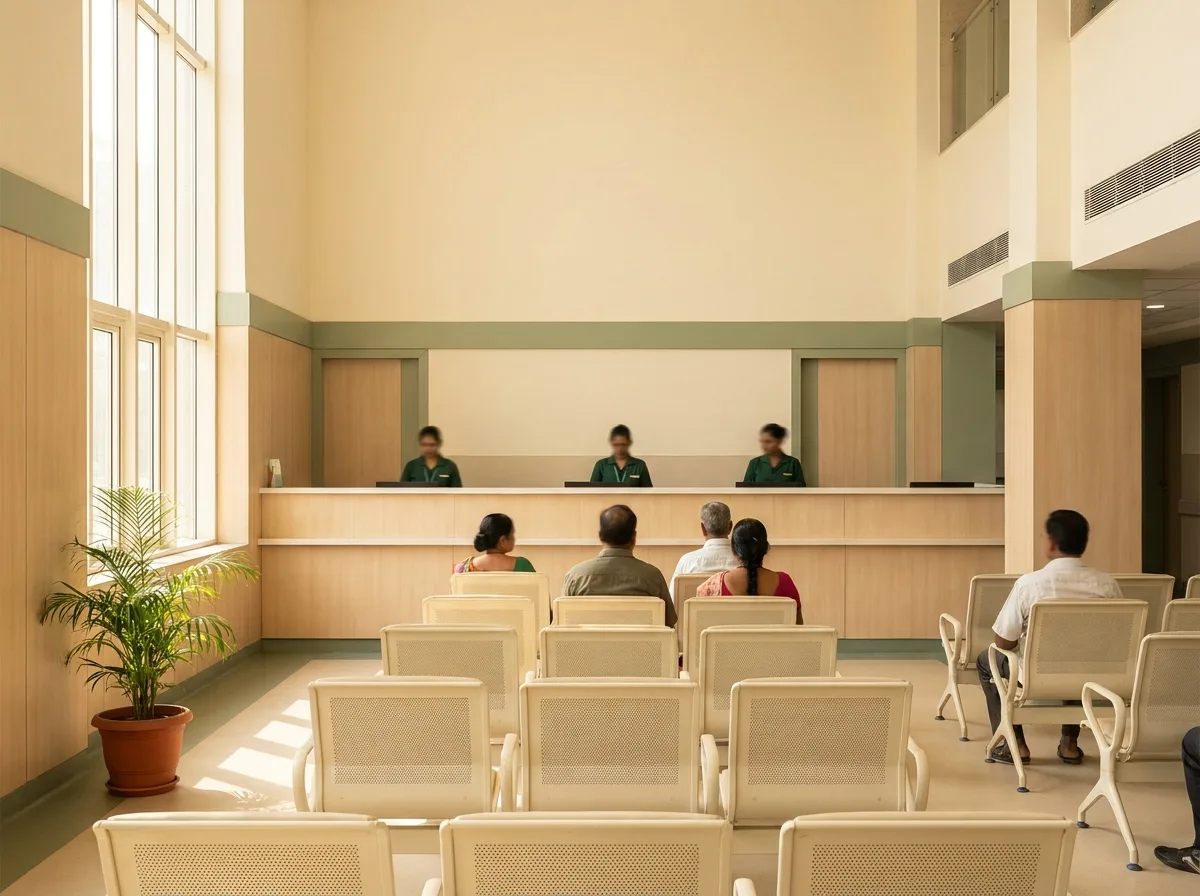
Routing patients to the right department on WhatsApp
A patient messages the hospital's WhatsApp number and, when it isn't obvious, the AI asks one short clarifying question: "Which department would you like: General Medicine, Orthopedics or Gynecology?", before issuing a token into that department's own queue. Patients who already know where they're headed skip the question entirely by scanning that department's own QR code posted at its counter, and go straight into the right line.
Referrals between departments, mid-visit
A general medicine consult that ends in "go get an ECG and come back" is routine in a hospital OPD and routinely breaks paper-token systems, which force the patient to pull a fresh number. TOKENN parks the original token in an awaiting-return lane instead, the same mechanism clinics use for lab-report loops, so the patient rejoins on the same token once the referred department is done, with no second queue and no lost place in line.
An OPD management system for a hospital: multiple entry points, one connected queue
Larger hospitals often run more than one registration counter: a main lobby desk plus a satellite counter near a busy department, sometimes on a different floor entirely. Every counter feeds the same live queue data, so a token issued at the satellite desk shows up correctly on the main lobby's display and vice versa. Reception at any counter sees every department's queue, not just the one physically in front of them.
Display boards across a hospital OPD floor
Each department or floor gets its own display, any TV or tablet already in the building, showing that department's now-serving token and announcing it out loud. In a hospital lobby, ambient noise and larger crowds make the audio call genuinely useful, not just a nice-to-have: patients waiting three rows back can still hear their number without straining to read a screen. A floor with three departments can run three department boards, or one combined board at the main entrance that lists every department's now-serving number, from the same TV browser and the same URL pattern.
What TOKENN deliberately does not do
It does not manage IPD admissions, bed allocation, discharge summaries, billing, insurance claims or EMR records, and it does not integrate with your existing HIS: by design, not by limitation. Hospitals evaluating queue software are often mid-way through, or wary of, a much larger HIS procurement; TOKENN sits entirely outside that decision. It runs on its own, alongside whatever hospital information system you have or plan to get, and never touches patient medical records.
Rolling out across an OPD block without an IT project
Hospital software procurement is normally a months-long cycle: vendor integration, IT sign-off, staff training across shifts. TOKENN skips all of it because there's nothing to integrate: each department is configured independently in minutes, using the WhatsApp Business number the hospital may already have. A pilot department can go live in an afternoon; the rest follow once reception sees it working. Most blocks start with two departments and add the rest a week later, once the first two desks trust it.
Pricing for a multi-department hospital OPD
One clinic account covers unlimited staff and departments configured independently, at ₹1 per token; most eight-to-ten-department OPD blocks fit comfortably inside one account. Hospitals with genuinely high footfall (1,000+ OPD visits/day) or multiple physical buildings should talk to us directly; the price stays ₹1 per patient rather than a flat hospital-wide premium.
What changes for hospital reception and floor staff
Before: a general enquiry counter fielding "which counter for cardiology" a hundred times a morning, plus department counters each running their own paper system with no visibility into each other. After: every counter sees every department's queue on one dashboard, walk-ins get routed and ticketed in two taps, and the enquiry counter's workload drops to the genuinely unusual cases; a patient with no clear department, a language the AI flags as unclear, a same-day emergency walk-in.
Daily analytics across every department
Hospital OPD administrators get a consolidated view (total patients seen, no-show rate and average wait across the whole block) plus a per-department breakdown that individual clinics never had reason to build. Over a few weeks this surfaces which departments are genuinely overloaded versus which just feel busy, turning a staffing decision that used to run on complaints and guesswork into something the dashboard can actually answer. The numbers are per department and for the block as a whole, so the OPD in-charge sees which counter is the bottleneck without asking anyone.
A hospital queue management system in India for nursing homes without a full HIS
Not every hospital searching for a queue management system already runs a hospital information system, plenty of nursing homes and 30-60 bed private hospitals in India still run OPD registration on a paper register or a basic billing tool, with no plans to buy an enterprise HIS soon. For these, TOKENN isn't a layer alongside a bigger system: it can be the entire OPD queue solution, department-wise, without waiting for a future HIS purchase to justify starting.
Why hospital OPD blocks resist the kiosk-and-ticket approach
The kiosk-and-printed-ticket model common in government and larger private hospitals solves the "what number am I" question but does nothing for "when should I actually walk into the building." Patients still arrive early and crowd the lobby around the kiosk itself, defeating the point of a numbered queue. A queue system that reaches patients on WhatsApp before they leave home is the only version that actually thins a hospital lobby rather than just organizing the crowd already inside it.
Hospital token system or hospital queue system: the software, the display and the price
Searches for a hospital token system, a hospital queue system or a hospital token management system usually mean three separate things, and it helps to name them. The software is the queue itself: who is next in each department, how long the wait is, and who has been called. The display is the screen in the corridor that shows the now-serving number and says it aloud. The price is what most hospitals ask about last and should ask about first, because the traditional answer is a token machine at ₹30,000 to ₹80,000 per counter plus a maintenance contract.
TOKENN is the software and the display in one, with no machine. Patients book a hospital token on WhatsApp or at the desk, so there is no hospital token booking app to install; each wing runs its own queue and its own display on the TV already on the wall; and the price is ₹1 per patient token, whatever the number of departments. A 250-patient OPD block spends about ₹7,500 a month, which is less than one year of one token machine's maintenance.
Frequently asked questions
What does a hospital token system cost?
A token machine with a display is ₹30,000 to ₹80,000 per counter up front plus a yearly maintenance contract. TOKENN is ₹1 per patient token with the software and the display included, so a 250-patient OPD block spends about ₹7,500 a month and buys no hardware.
Is there a hospital token booking app for patients?
No app. Patients book by messaging the hospital's WhatsApp number or scanning a QR at the gate, and reception issues walk-in tokens from a browser. Apps get installed once and deleted; WhatsApp is already on the phone.
Does TOKENN replace our HIS or hospital management software?
No. TOKENN manages the outpatient queue and WhatsApp booking only: it doesn't touch admissions, billing, bed management or medical records, and needs no integration with your HIS.
Can it handle IPD or admissions?
No. TOKENN is OPD-only, by design. If you need IPD or ward management, that stays with your HIS; TOKENN runs alongside it purely for the outpatient queue.
How many departments can it handle?
As many as your hospital runs. Each department gets its own token series, hours and QR, configured independently in minutes.
Can patients be routed to the right department automatically?
Yes. The AI asks a short clarifying question if it isn't obvious, or the patient scans that department's own QR to book directly into it.
What happens when one department refers a patient to another mid-visit?
The original token is parked in an awaiting-return lane; the patient rejoins the same token once the referred department is done: no second queue.
Do we need separate hardware for every floor or department?
No. Any existing TV or tablet becomes that department's display, showing its own now-serving token and calling it out loud.
Try TOKENN for your clinic
₹1 per patient · start with 150 tokens for ₹149 · nothing expires · no hardware · set up in 10 minutes. See pricing.
See also
WhatsApp token booking for clinics: a queue number by message, no app →
Paper token vs digital token system for clinics: what a small clinic actually gains →
Cardiology clinic queue management on WhatsApp: ECG, echo and consult in step →