Eye clinic queue management on WhatsApp: optometry, doctor and dispensary in step
Eye clinics are quietly one of the most complex outpatient operations around. A single patient can pass through optometry, the doctor and the dispensary in one visit, in an order that depends on why they came. Eye clinic queue management is therefore not one queue but three that share patients, and a system built for a single doctor's door breaks on the first spectacles patient. TOKENN runs each station as its own queue, with its own pace, and lets every patient watch their place on WhatsApp instead of hovering at the desk.
Three rooms, three queues, one patient
A new spectacles patient goes eye test, then doctor, then dispensary. A cataract follow-up goes eye test, then ophthalmology. A glaucoma pressure check is ophthalmology only. In TOKENN each station is its own department queue with its own hours and its own realistic minutes-per-patient. The optometrist sees their queue, the doctor sees theirs, the dispensary sees theirs. When a patient finishes at one station, reception issues their token for the next one in two taps, and the patient checks their position on WhatsApp rather than asking. The three queues stop blocking each other because they were never one queue to begin with.
An ophthalmology check-in system without the check-in crowd
The doctor's queue carries the widest mix: routine consults, day-one post-op patients, chronic monitoring visits. A patient one day after cataract surgery is often elderly, often with an eye still patched, and often driven by a family member. That family member books the token on WhatsApp from home and the patient arrives when they will actually be seen, instead of sitting two hours in a bright waiting room with a bandaged eye. A patient who arrives unannounced gets a walk-in token at the desk and joins the same queue. Everyone gets the message when two patients are ahead, and the display calls each number aloud, so nobody watches the door.
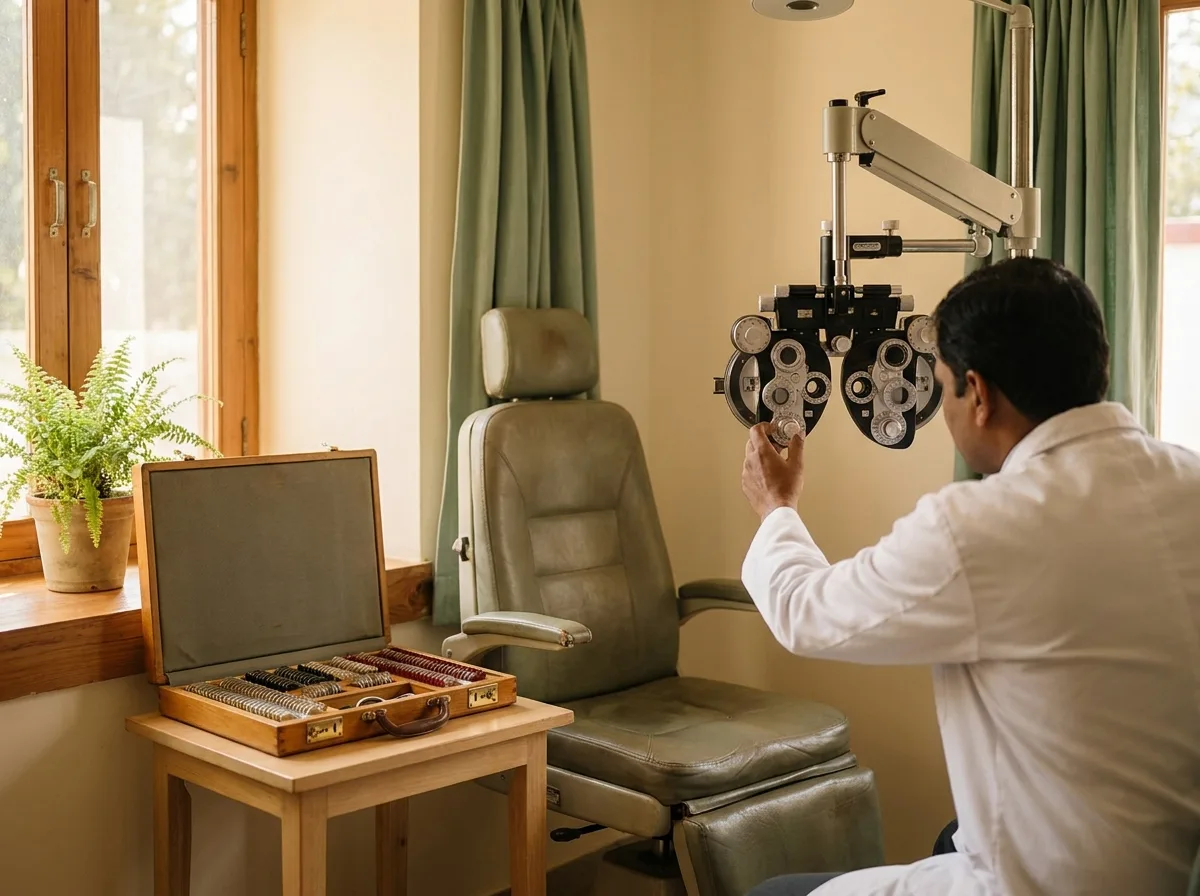
An optometry queue system with its own pace
Refraction takes a few minutes. A first contact-lens fitting, with the teaching session, takes twenty-five, and the follow-up to check for irritation takes five. A child's vision screening takes as long as the child allows. Running optometry as its own queue with its own minutes-per-patient means the estimate for the person behind a lens fitting is honest, and a five-minute check is never estimated as if it were a fitting. Families arriving together at the start of a school year get one token each in a few taps and move through close together.
The dispensary runs on a different clock
Custom lenses take five to seven days, so the dispensary spends its day on collections and walk-in browsing while the consult rooms run a clinical queue. As its own department, someone collecting a finished order is not stuck behind a full ophthalmology list, and the browsing customer never blocks a patient. TOKENN does not track order status or tell a patient when their lenses have arrived; that stays with however the dispensary works today.
Surgery days and the pre-op morning
Cataract surgery days bring their own crush: pre-op checks, biometry and consent counselling, often all in one morning before the surgical list. Running pre-op as its own queue keeps that workflow from competing with a same-day walk-in's simple consult for reception's attention, and the OPD queue for routine patients runs beside it untouched. Each attendance is a token on the day in the queue it belongs to. Where a patient is across a longer pathway, a LASIK work-up over several weeks for instance, lives in your records, not in the queue.
What stays in your records, and what the assistant will not do
Glaucoma, diabetic retinopathy and macular degeneration need monitoring visits that patients are bad at keeping once they feel fine. Which patient is due when is clinical scheduling and stays in your records; TOKENN holds no history and sends no recall messages. What it changes is the visit: a short pressure check that used to cost a morning becomes a token booked on WhatsApp with an honest wait, which is one fewer reason to put it off. The assistant books, checks status, cancels and gives directions in Tamil, Hindi, English and the mixed forms people type. It does not answer clinical questions. "My eye is still red, is that normal?" goes to a human.
Setting up an eye clinic on the platform
A typical eye clinic sets up three queues in its first session, optometry, ophthalmology and dispensary, each with hours and a realistic minutes-per-patient, and adds a pre-op queue if it operates. Most practices are booking on WhatsApp and running the waiting-room display the same day, and nothing clinical moves. The first 150 tokens are ₹149; the price is on the pricing page.
Eye clinic software, and the queue that sits in front of it
Eye clinic software and eye hospital software run the clinical side: refraction records, imaging, optical billing, sometimes the dispensary stock. None of it manages the three-stage wait between optometry, the ophthalmologist and the counter, which is where the room fills. TOKENN runs that wait as three queues on WhatsApp beside whatever eye care software the clinic already uses, with no integration, at ₹1 per patient.
Frequently asked questions
Can patients pass through optometry, the doctor and the dispensary in one visit?
Yes. Each station is its own queue, and reception issues the patient's token for the next station in two taps when they finish the current one.
Can each station have its own wait estimate?
Yes. Every queue carries its own minutes-per-patient, so a five-minute pressure check and a 25-minute lens fitting produce different, honest estimates.
Can pre-op cataract patients be kept separate from routine OPD?
Yes. Pre-op runs as its own queue, so surgical-day work never competes with same-day walk-in consults.
Does TOKENN send recall reminders for glaucoma or diabetic screening?
No. It holds no patient history and sends nothing between visits. Monitoring intervals stay in your records; TOKENN handles the visit itself.
Does it work for chains with several branches?
Each branch runs its own account and queues. Message us and we will set up a multi-branch arrangement.
How long does it take a new eye clinic to go live?
Most practices are booking on WhatsApp and running the display within the first day. There is nothing clinical to migrate.
Try TOKENN for your clinic
₹1 per patient · start with 150 tokens for ₹149 · nothing expires · no hardware · set up in 10 minutes. See pricing.
See also
Clinic queue app vs WhatsApp token system: which one do patients actually use? →
WhatsApp token booking for clinics: a queue number by message, no app →
Paper token vs digital token system for clinics: what a small clinic actually gains →