WhatsApp AI receptionist for clinics: the “what number is on now?” calls, answered without your desk
An AI receptionist for clinics is software that takes the routine front-desk conversations, "give me a token", "how long is the wait", "I can't come today", off the human receptionist. Most AI receptionists answer phone calls. TOKENN's works inside WhatsApp, where Indian patients already message, so nobody is put on hold, no accent is misheard, and the patient keeps a written record of every reply.
A virtual receptionist for doctors on text, not voice: why WhatsApp beats a phone-answering AI
A voice AI has to pick up in time, understand a Tamil-Hindi-English mix over traffic noise, and speak an answer the patient must remember. A WhatsApp assistant has none of those problems, because the patient is not calling. They send a message, they get a written reply they can scroll back to, and the conversation costs the clinic a fraction of a rupee rather than a per-minute call charge.
| Phone-call AI receptionist | TOKENN on WhatsApp | |
|---|---|---|
| Missed contact | A call that is not answered in time is lost | Messages wait; nothing is lost |
| Accents, noise, mixed language | Must be recognised live from speech | Read as typed, in Tamil, Hindi, Tanglish, Hinglish or English |
| What the patient keeps | Whatever they remember | The token, the wait and the reminders, in the chat |
| Reminders | Needs an outbound call | 2-ahead and your-turn messages, automatically |
| Cost model | Typically billed per minute of talk time | Messages included in the plan; ₹0.20 each beyond the cap |
| Patients without a smartphone | Can still call | Reception issues a walk-in token in two taps; same queue |
| Medical questions | Depends on the vendor | Never answered; always handed to a human |
What an automated clinic receptionist handles without a human
Issuing the next token with an estimated wait and an arrive-around time. Answering "status" with the patient's position, minutes remaining and the number being served. Cancelling. Telling patients the clinic's hours and address. Booking ahead of opening, with the opening time and place in line. Sending the 2-ahead reminder and the your-turn alert. Explaining, politely, that the queue is closed, that the clinic is shut today, or that the day's token limit has been reached and reception can help.
It also refuses to double-book: a phone that already holds a token is reminded of it rather than given another. That single rule removes most of the "I booked twice by mistake" mess a paper register never catches.
What it hands to your staff
Anything medical, every time. Anything it does not understand after one clarifying question. Voice notes, which it asks the patient to type out rather than guess at. And urgency: if a patient mentions chest pain, breathing difficulty or an accident while booking, the token is issued and the message is flagged on the dashboard so reception notices the case at once.
Staff see every conversation and every token. Reception can cancel, reissue, prioritise with "Call now", or park a patient who has gone for tests in the awaiting-report lane, all with one tap. The AI never has the last word over a human.
The receptionist's phone, before and after
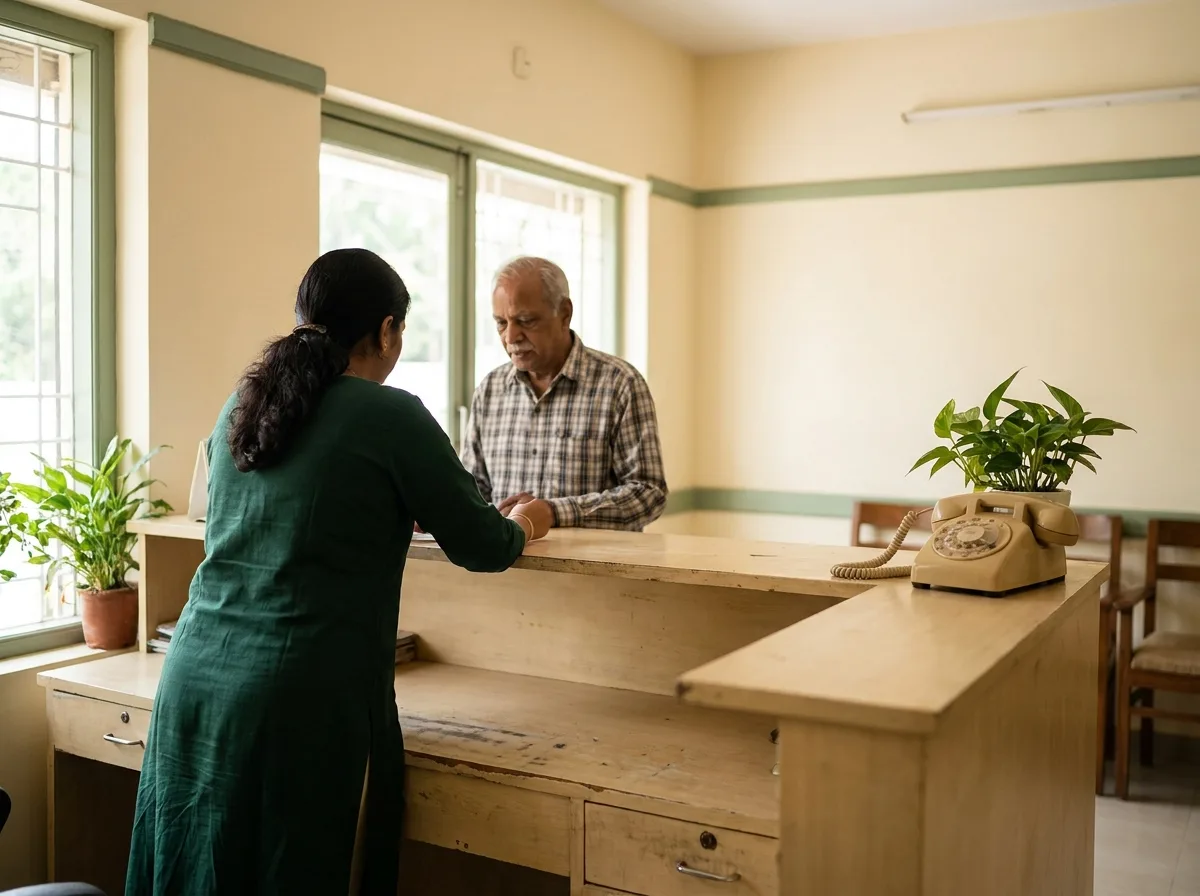
Before: between nine and eleven the phone is a stream of the same question in different words, and each call interrupts a patient standing at the desk. After: the questions arrive as messages and are answered by the assistant in seconds, so the phone rings for the things that need a person, such as a reschedule, a question about a report, or a first-time patient who wants to talk. The desk does not get quieter because there are fewer patients; it gets quieter because the repetitive part is gone.
This is the same assistant that powers the OPD queue and the multi-doctor dashboard; the receptionist role is simply the part patients see.
The other change is the part of the day nobody staffs. Patients message when it occurs to them, which is often nine at night or the middle of a Sunday, and those messages used to sit unanswered until someone opened the clinic. The assistant answers them then and there: it books into the next session where advance booking is allowed, gives the opening time where it is not, and says plainly when the clinic is shut. Monday morning starts with a queue rather than with a backlog of missed calls to return.
Never a diagnosis
The assistant handles queue tasks. It does not diagnose, does not suggest treatment, and does not tell a patient whether to worry. That boundary is fixed in how it is built, not left to a prompt a vendor might change. A clinic's WhatsApp number is a clinical channel, and the assistant behaves like a good receptionist on it: helpful about logistics, silent on medicine, quick to fetch a human.
What "structured" means, in plain terms
A lot of clinic software says "AI-powered" without saying what that means. For a queue assistant it means every incoming message is classified into one of a small set of known actions, book, check status, cancel, or hand to staff, before anything else happens. That constraint is deliberate. An assistant that can say anything is unpredictable; one that can only take a handful of defined actions is auditable, and auditable is what a clinic needs from software on its patient channel. It is also why the assistant does not answer medical questions even when it could produce a plausible sentence: there is no "give medical advice" action for it to take. The boundary is not a filter bolted on afterwards; it is a category the system was never built to reach.
A morning on an AI front desk for a clinic
At 8:40 a patient messages "doctor irukkaanga?". The assistant checks whether the queue is open, says yes, and issues a token. At 9:15 another messages "eppo varum en number?", a status check answered from the live queue in a second. At 9:40 a third replies "cancel pannunga, வர முடியாது"; the token is released and the slot moves to the next patient. None of the three touched the reception phone. Then a fourth message: "doctor, I have chest pain since morning." The assistant does not advise. It issues the token, flags the message as urgent on the dashboard so reception notices at once, and steps aside. That handover, automatic and immediate, is the whole reason for drawing a hard line around what the assistant may decide.
The thirty-second test for any AI receptionist
Ask a vendor one thing during a demo: type a message with a typo, a regional phrase and no punctuation, and watch. A genuinely AI-first assistant handles it without a pause. A menu bot with an "AI-powered" label breaks or replies with something generic. Old-style WhatsApp bots that answer "Type 1 to book, Type 2 for timings" fail the moment a patient types anything that is not a number, which in practice is most of the time. Staff trust follows the same evidence. For the first few days reception keeps half an eye on the dashboard; by the end of the first week, after dozens of correct tokens and status replies, the double-checking fades on its own. Clinics that try to force that trust on day one get more resistance than the ones that let staff watch it work.
An AI receptionist in India: setup and what it costs
It runs on Meta's official WhatsApp Cloud API on your clinic's own number; the setup guide covers the Meta side, and it takes about ten minutes if you already have a WhatsApp Business account. There is no hardware and nothing for patients to install.
There are no plans: ₹1 per patient token, WhatsApp messages included, bought in packs that never expire. There is no per-minute charge because nobody is on a call. Start with 150 tokens for ₹149; nothing expires. See the pricing page.
An AI receptionist for doctors, dental clinics and medical offices
The phrase covers very different products. An AI receptionist for a medical office in the United States answers phone calls and books calendar slots. An AI receptionist for doctors in India has a different job, because patients here message rather than call and clinics run on tokens rather than calendars. TOKENN's assistant lives on WhatsApp: it issues the token, answers the status question in the patient's own language, takes a cancellation and sends the reminders.
For a dental clinic it means the receptionist stops answering the same how-long-more message forty times a morning; for a solo GP it means the booking line is open at 6 am without anyone at the desk. It never gives medical advice, and it hands anything it does not understand to a human. Every reply is inside the ₹1 per patient token, so there is no per-call or per-minute charge.
Frequently asked questions
Does the AI receptionist answer phone calls?
No. It works on WhatsApp. Patients message instead of calling, and get a written reply they can keep.
What can it do on its own?
Issue tokens, answer status questions, cancel, give timings and location, book ahead of opening, and send 2-ahead and your-turn reminders.
What does it pass to a human?
Any medical question, anything unclear after one clarifying question, voice notes, and flagged urgent cases.
Which languages does it handle?
Every major Indian language plus English and code-mixed Tanglish and Hinglish, replying in the language the patient used.
Is it billed per minute?
No. Messages are included in the plan up to its cap; beyond that they are ₹0.20 each.
Can reception override it?
Yes. Every token can be cancelled, reissued or prioritised from the dashboard with one tap.
Try TOKENN for your clinic
₹1 per patient · start with 150 tokens for ₹149 · nothing expires · no hardware · set up in 10 minutes. See pricing.
See also
Polyclinic software for multi-doctor clinics and group practices: a live queue per doctor →
Token system vs appointment system for clinics: which one fits your OPD →
Gynecology clinic queue management on WhatsApp: numbers, never names →