OPD queue management and OPD token system on WhatsApp
An OPD token system gives every outpatient a number in order; an OPD queue management system also tells each patient when to come. Outpatient departments fail at the same point every morning: 60 patients arrive in the first hour, and the doctor sees them across six. The room is full by 9:15 and angry by 10:30. An OPD queue management system only earns its keep when it moves that wait out of the lobby, which means reaching patients on the phone already in their pocket. TOKENN runs the whole OPD queue on WhatsApp: tokens by message, walk-ins from the desk, a display on the TV you already own, and a reminder when two patients are ahead.
What an OPD queue management system has to do
Strip away the vendor language and an OPD queue system has four jobs. Token issue: every patient gets a number in order, whether they booked from home or walked in without a phone, and both land in one queue. A system that keeps two lists, bookings on one and walk-ins on another, creates the exact fairness dispute it was bought to end.
The live queue: one screen for staff that shows who is being seen, who is next and how long everyone else is likely to wait, updating the moment a patient is called, cancels or is marked done. It has to survive what a real OPD does to it: an emergency seen out of turn, a patient sent for a blood test and back, a doctor who starts twenty minutes late.
Calling patients: a number on a wall display, spoken aloud, so the receptionist is not shouting names across the hall. This is the part hardware vendors sell hardest and the cheapest to solve, because any TV with a browser does it.
Reaching the patient at home: a message when they are two patients away and another when it is their turn. This is the part most systems leave out, and it is the only one that decides whether the waiting room is calm or crowded. Without it, the other three organise a crowd that did not need to exist.
Why the wall display is the wrong place to start
Token boards and paper slips solve the wrong half of the problem. They tell patients their number but not when to arrive, so patients show up at opening time anyway, just in case, and the room fills. A digital token display for OPD makes no difference to a lobby that is already full at 9:15.
The OPD's problem is rarely order. A stack of slips gives you order. The problem is that nobody told the sixtieth patient that the doctor will reach them at half past eleven. Most OPD software stops at records and billing; the queue needs a channel that reaches patients while they are away, and WhatsApp is the messaging app most Indian patients already have, with nothing to install.
Paper, kiosk, app or WhatsApp: four ways to run an OPD queue
Paper tokens. A numbered slip from reception: free, instant, and nobody is excluded. It gives you order and, with a whiteboard, a way to call. It does nothing for the live queue and nothing for reaching the patient, so everyone arrives at opening.
A queue kiosk. A machine at the door prints the slip and a bundled board shows the number. It does the first three jobs and the fourth not at all, costs ₹30,000 to ₹80,000 plus an annual maintenance contract, and when the printer jams on a Monday you are back to shouting. It suits a hospital wing or a lab chain with anonymous walk-ins, and almost no small clinic. The clinic queue kiosk alternative page has the three-year maths.
A patient app. Your own app on the Play Store. It can do all four jobs, but only for patients who install it, which for a clinic visited twice a year is a minority, and the reminder arrives only if notifications were allowed and the app survived the week.
WhatsApp. The patient scans a QR or sends a message, gets a token and an arrival time, and receives the reminders in the same thread. Nothing to install, because the app is already on the phone. Walk-ins are issued from the dashboard into the same queue and the display runs on any TV. This is the only kind that does the fourth job for everyone, which is why TOKENN is built this way.
| Paper | Kiosk | Patient app | ||
|---|---|---|---|---|
| Issues tokens in one queue | Yes | Walk-ins only | App users only | Yes, bookings and walk-ins |
| Live queue for staff | No | Basic | Yes | Yes |
| Calls patients on a display | Whiteboard | Bundled board | Rarely | Any TV or tablet |
| Reaches patients before they arrive | No | No | If installed and notifications allowed | Yes, 2-ahead and your-turn messages |
| Upfront cost | ₹0 | ₹30,000 to ₹80,000 | Development or licence | ₹0 |
| Ongoing cost | Slips | Maintenance contract, paper rolls | Monthly licence, app store upkeep | No subscription; plans from ₹149, WhatsApp messages included |
An OPD token system on WhatsApp: how it runs a real morning
The patient scans the clinic QR on the desk, the door or your Google listing, and WhatsApp opens with the message ready. Or they type "token" in whatever they use: Tamil, Hindi, Tanglish, English. The assistant issues the next number and replies with the token, the estimated wait and an arrive-around time. If the clinic has not opened yet, it gives the opening time and their place in line instead. The patient's side of this, message by message, is on the WhatsApp token booking for clinics page.
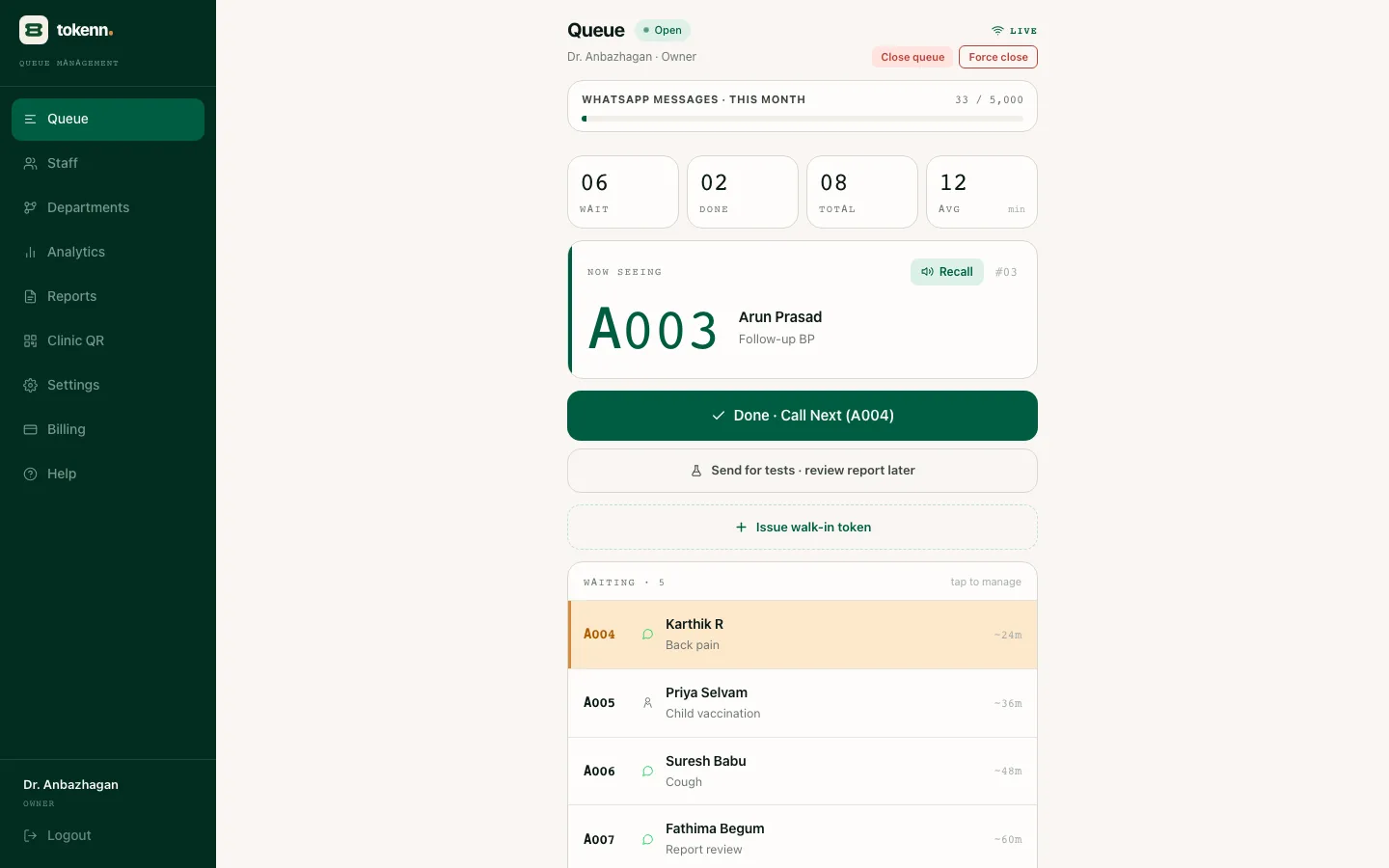
The token appears on reception's dashboard the same second, marked as a WhatsApp booking. Elderly patients and anyone without WhatsApp get a walk-in token in two taps and take the next number in the same queue. When the doctor finishes, reception taps "Done, call next": the TV announces the number, the next patient gets a your-turn message, and the patient two places back gets the 2-ahead reminder. A patient who cannot come replies "cancel" and the slot moves on.
The display itself is the waiting-room TV you already own, showing now-serving and the next four numbers and calling each one aloud.
How OPD token numbers work: departments, walk-ins and the call
Each department has its own letter. The general OPD is A by default; add dental as D or a lab as L, and the third dental patient of the day is D003 while the general OPD is on A041. The letter keeps two queues apart on one board, so no patient waits through someone else's numbers. Numbers start again at 001 every morning.
WhatsApp bookings and walk-ins draw from the same sequence. A patient who books from home at 8:10 gets A012; the walk-in at the desk a minute later gets A013. Nobody holds two kinds of ticket, and reception never has to explain why a number was skipped.
When reception taps Done, call next, the waiting-room TV shows the number and says it aloud: "Token number D, 0, 0, 3", twice, then the room the department sits in. Many smart-TV browsers, Samsung and Mi among them, have no built-in voice; on those the board plays a recorded voice instead, so the call is heard on whatever TV the clinic already has. A TV browser plays sound only after one tap on the screen or a press of the remote's OK button, so tap once when you open the board.
OPD counter management: emergencies, lab returns and the doctor who runs late
A rigid first-come-first-served list cannot handle what an OPD actually does. In TOKENN, reception taps any waiting patient and chooses "Call now": that patient is seen next, everyone else shifts by one, and every wait estimate updates live. The assistant also flags urgency from the patient's own words, chest pain, breathing difficulty, an accident, as a hint on the dashboard, so the receptionist notices the case the moment it books.
Half an OPD visit is not one visit. The doctor sends the patient for a blood test or an X-ray and needs them back with the report. Do not make them pull a new token. Staff mark the patient "sent for tests", the token is parked in an awaiting-report lane, the queue moves on, and when the patient returns one tap brings them back to the doctor on the same token.
And when the doctor starts late, nothing has to be re-promised. The queue never told anyone "11:20": before the first call a patient is told their place in line rather than a guessed wait, and if the doctor is held up, reception taps Doctor running late and every waiting patient hears it on WhatsApp, with the delay added to every wait they see. That is the difference between an OPD token system and an appointment book, and it is why general OPD, with a five-minute refill next to a twenty-minute new-patient workup, needs the former. A department whose visits genuinely run to a fixed length, a dentist's chair or a physiotherapy room, can run on WhatsApp appointments instead while the OPD stays on tokens.
The receptionist's day, before and after
Before: the phone rings every few minutes with "how many ahead of me", reception juggles a paper register while greeting walk-ins, and by 10 AM the desk is a small crowd asking the same question in different words. After: patients check their own position on WhatsApp, walk-ins get a token without breaking stride, and the phone rings for the handful of things that need a human, a reschedule, a question about reports, a new patient's first visit. The job does not get easier because there are fewer patients. It gets easier because the repetitive 80 percent of interruptions disappears.
Tamil, Hindi, Tanglish: the multilingual OPD
An Indian general OPD rarely serves patients in one language, even in one city. A Tamil-speaking elderly patient, an English-comfortable professional and a Hindi-speaking migrant worker can share a waiting room on the same morning. The assistant reads and replies in English and 18 Indian languages, from Tamil, Hindi and Telugu to Bengali, Odia and Urdu, and in whichever code-mixed style the patient writes in, so language is never the reason a patient calls instead of messaging, or the reason an elderly patient feels shut out of the digital queue. It books, checks status, cancels and gives directions. It does not answer medical questions; anything clinical is handed to a human.
What an OPD queue management system costs in India
Paper is ₹0 plus the receptionist's morning. A kiosk is ₹30,000 to ₹80,000 upfront, then a maintenance contract of a few thousand rupees a year, paper rolls and the occasional service visit; a ₹50,000 kiosk with a ₹6,000-a-year contract is roughly ₹68,000 over three years. A patient app is usually a monthly licence, sometimes with per-patient fees, plus the cost of keeping it working across two app stores, which the vendor rarely itemises.
TOKENN is pay-as-you-go: prepaid plans of booking credits with WhatsApp messages, reminders and multiple departments included, and credits never expire. There is no hardware beyond the TV you own and no integration project, because it does not touch your EMR or billing. The first 50 booking credits are free, enough to test it on a real morning, and the Starter plan of 150 credits costs ₹149, less than one consultation fee. The full breakdown is on the pricing page.
Setting it up without disrupting a running OPD
Sign up with the clinic's WhatsApp number and name the clinic. The TOKENN team then checks the doctor's medical registration by hand; once that is done the clinic takes bookings on TOKENN's WhatsApp number, with the clinic's name in every message, so there is no WhatsApp Business account to set up. Print the QR, put it on the desk and the door, and set the clinic's hours so the queue opens and closes on its own. Put the display on the waiting-room TV the same afternoon.
Then run both systems for a day. Keep issuing paper slips at the desk if you like, but issue them through the dashboard as walk-in tokens so there is one queue, not two. Do not let a kiosk and the software both hand out numbers; two queues guarantee a dispute by ten o'clock. By the second morning most receptionists prefer the dashboard, because it is the thing that stops the phone ringing.
The change that takes longest is not technical. It is patients learning that they can wait at home, and that happens one visit at a time, as each patient sees the reminder work once. Expect the room to thin noticeably within the first week and to keep thinning for a month.
How you know it is working
Three signals in the first week. The phone stops ringing for "what number is on now?", because patients ask the assistant. The waiting room at half past nine holds the four or five people who are genuinely next, not twenty-five. And cancellations arrive as messages instead of empty slots.
After a month the dashboard tells you things paper never could: patients seen per day, no-show rate, average wait and your real peak hour. Most OPDs discover their crush is not the 9 AM opening but a window around 10:45 that nobody had measured, and staff or schedule around the real pattern instead of the guessed one. Our guide on reducing patient waiting time in the OPD covers what to do with that data.
Seven questions to ask before you choose
Does it reach the patient before they arrive, on a channel they already use? Do walk-ins and bookings share one queue? Can reception handle an emergency and a lab return without a phone call? Does the display run on a TV you own? Does it reply in the languages your patients write in? Is the price published, and does it include messaging? Does the assistant refuse to give medical advice? A system that answers yes to all seven is an OPD queue management system in the full sense. One that answers yes to three is a token printer.
OPD token online, and where OPD management software fits
An OPD token online is the whole idea: the patient gets the token before leaving home, on WhatsApp, and arrives when the queue says so. There is no OPD token app to install and no OPD token machine or dispenser at the counter, because the token lives in the chat and the OPD token display is a web page on the waiting-room TV. Walk-ins who arrive without booking get a token from reception in two taps and join the same queue.
Clinics searching for OPD software or OPD management software usually want more than a queue: OPD billing software that prints the receipt, prescriptions, patient records, sometimes IPD. TOKENN is not that, and says so plainly. Hospital OPD software of that kind is quoted at ₹3,000 to ₹8,000 a month and takes a rollout; the queue is the part it does worst, because it lives on the billing desk and never reaches the patient at home. TOKENN is the OPD token system that runs beside whatever OPD software for clinic or hospital you already use, needs no integration because it only holds the queue, and runs on prepaid plans from ₹149 rather than a monthly licence. If you have no OPD software at all, start with the queue: it is the part patients feel.
Frequently asked questions
How does an OPD token system work?
Each patient gets the next number in their department's sequence, such as A012, whether they book on WhatsApp or walk in. Reception calls numbers in order, the TV shows and announces each one, and patients two places away get a WhatsApp message to come in.
Can patients get an OPD token online?
Yes. They message the clinic's WhatsApp number or scan the QR, and the token comes back in a few seconds with a live wait estimate. No OPD token app, no login, no download.
Do we still need an OPD token machine or display board?
No machine. The OPD token display is a web page that a smart TV browser opens, showing the now-serving number and the next four, and calling each number aloud, with a recorded voice on TVs that have none of their own.
What is the best way to manage OPD waiting?
Move the wait out of the lobby: give every patient a token with a live position and message them on WhatsApp when two patients are ahead, so they arrive minutes before their turn instead of hours.
What is the difference between an OPD token system and an OPD queue management system?
A token system issues numbers. A queue management system also tracks the live position, estimates waits, handles emergencies and lab returns, and reaches patients before they arrive.
Do we need a kiosk or other hardware for an OPD queue?
No. A phone or laptop for reception and any TV or tablet for the waiting-room display is enough. Kiosks suit high-volume anonymous walk-in settings, not small clinics.
What about patients who don't use WhatsApp?
Reception issues a walk-in token in two taps. It joins the same live queue as the WhatsApp bookings and shows on the display.
Does a patient need a new token after a lab test?
No. Mark them "sent for tests"; when they return with the report, one tap recalls them to the doctor on the same token.
How long does setup take, and can we run morning and evening shifts?
Bookings start once our team has checked the doctor's registration, which is done by hand. Setting the hours, printing the QR and opening the board on the TV take minutes after that. Set both shifts in Settings and the queue opens and closes at the boundary times on its own.
Try TOKENN for your clinic
50 free booking credits · plans from ₹149 · credits never expire · no hardware · set up in 10 minutes. See plans.
See also
WhatsApp token booking for clinics: a queue number by message, no app →
Paper token vs digital token system for clinics: what a small clinic actually gains →
Dental clinic queue management on WhatsApp: one queue per chair →