The question your receptionist answers forty times a morning
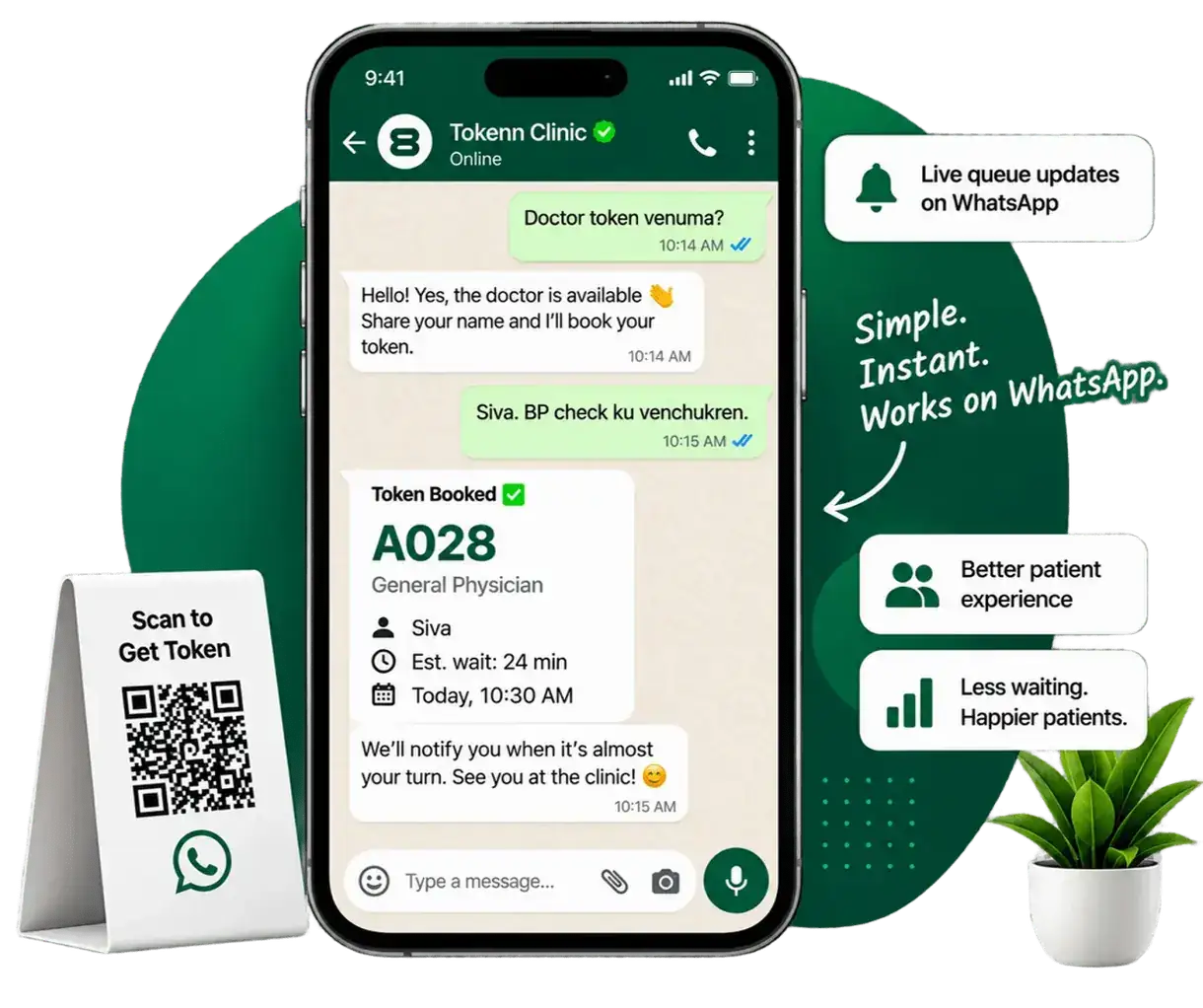
"How many ahead of me?" Every clinic hears it all morning, at the desk and on the phone. With TOKENN the answer goes out by itself. The patient gets a WhatsApp ping when two people are ahead, and the TV in the waiting room shows the same number. So they wait at home, or in the car, and walk in when it's nearly their turn instead of at 9 AM "to be safe". Read the guides on cutting OPD waiting time.
Younger patients book on WhatsApp. Older ones still walk in.
Both are fine. Someone who doesn't use a smartphone walks up like always, and your receptionist gives them a token in two taps. Same queue, same display, and a WhatsApp reminder if they leave a number. One front desk automation flow covers everyone. That is what an AI receptionist for clinic front desks should do: take the repetitive part, not the person.
Why most clinic queue management software in India fails small clinics
Most of it was built for hospitals. A kiosk in the lobby, an LED board, an integration project, a training day. A two-doctor clinic has none of that and doesn't want it. So the clinic runs on paper tokens and phone calls. It works, mostly. But a queue built on slips of paper and "please call back later" loses a few patients every week to the clinic down the road that texts them back.
TOKENN doesn't change how your clinic works. Keep your EMR, your billing, your way of doing things. The queue simply moves onto WhatsApp, with nothing to integrate.
Your front desk shouldn't be a call centre. Between 9 and 11 the phone rings with one question in three languages: "எத்தனை பேர் இருக்காங்க?", "abhi number kab aayega?", "doctor, how much longer?" TOKENN answers each one on its own, in the language the patient used, and your receptionist gets to look up from the phone.
What a clinic queue management system actually does
Strip away the jargon and a clinic queue management system does four jobs. It gives each patient a number. It tells them how long they'll wait. It calls them in order. And it shows the front desk who's next. Hospitals have had this for years, as a kiosk and an LED board. Small clinics mostly haven't, because the hardware costs more than a month of rent.
TOKENN is the same four jobs, done on WhatsApp. Patients get their number by QR or message. Walk-ins get one from the desk, through a two-tap digital token system for clinics. The queue keeps the order fair, lets the doctor pull an emergency forward, and reworks every wait estimate when a consult runs over. Reminders go out on WhatsApp. The display is your TV.
A doctor who runs on fixed times can take appointments on WhatsApp instead: the patient picks a day and a free slot in the same chat and gets a reminder before it. Tokens or appointments is a choice per doctor, not per clinic.
It isn't an EMR and it isn't billing. It sits next to whatever you use today, with nothing to integrate. If your day is a general OPD, the OPD queue management page walks through session hours, token series and the report-review loop in detail. If you've been looking at patient apps, this is a clinic queue management system without app installs. Think of it as clinic appointment software without app friction, because everyone already has WhatsApp.
Who it's for: a solo GP or a two-doctor clinic in a Tier-2 city, seeing 30 to 200 patients a day, where the receptionist is also the phone operator. Who it isn't for: a hospital IT department buying a HIS module. The price says as much. One rupee a patient, against ₹30,000 to ₹80,000 for a kiosk. Nothing monthly, nothing expires.
Two ways patients join, chosen per doctor
Tokens for walk-in OPDs, time slots for doctors who run on fixed times. Same WhatsApp number, same ₹1.
- Token queue: the patient messages and gets the next number, a live wait, a nudge when two are ahead and a your-turn alert. Best where consult length varies: general OPD, pediatrics, walk-in mornings. WhatsApp token booking.
- Appointments: the patient picks a day and a free time from a WhatsApp list, says what the visit is for, typed or as a voice note, and gets a reminder before the slot. Best for fixed-length visits: dental work, physiotherapy sessions, specialist reviews. WhatsApp appointment booking.
- Both, in one clinic: the GP runs on tokens, the dentist on appointments. Each has its own QR and number series, and reception sees the live queue for one and the day's book for the other on the same dashboard. Which one fits each doctor.
How the clinic token system works, in three steps
Three things change. Everything else about your clinic stays exactly as it is.
- The patient scans or messages. There's a QR at your desk and on the door. Scanning it opens WhatsApp with the message ready. Or they type whatever comes naturally, like "Doctor irukkanga?" (Tamil for "is the doctor in?"). Either way works.
- A token comes back in about 3 seconds. The assistant reads English and 18 Indian languages, and the mixed Tanglish and Hinglish people actually type. It replies in the same language with a token number and a live wait estimate. It books, checks status and cancels. It never gives medical advice. Your staff see every token on the dashboard and can override with one tap.
- A nudge when two patients are ahead. Then a "your turn" message with the token number, and the TV in the waiting room announces it. Nobody crowds the desk to ask.
Less crowding: no more repeated questions at the desk. Smooth clinic flow: patients know their wait time. Happier patients: a simple, familiar WhatsApp experience. Works for your team: see everything on a dashboard, override anytime.
How WhatsApp appointment booking works, in three steps
For a doctor or department that works to fixed times, the same WhatsApp number books a slot instead of a token.
- The patient picks a day and a time. Each appointment department has its own QR. Scanning it opens WhatsApp; TOKENN replies with the days that have free slots, then the free times on the day they tap. No app, no form, no call to reception.
- Name and reason, then it is booked. They send the patient's name and what the visit is for, typed or as a voice note in any language. The doctor gets one short English line, and the patient gets the day, the time and their number, with Reschedule and Cancel buttons.
- A reminder, then they are called. Two hours before, a reminder with I'll come and Cancel. At the clinic, reception checks them in and they join the queue, and the TV calls their number like any token. WhatsApp appointment booking.
One screen for the receptionist. One for the waiting room.
The whole morning's queue updates the moment a patient books, cancels, or gets marked done. There's nothing to learn. It looks like what it does.
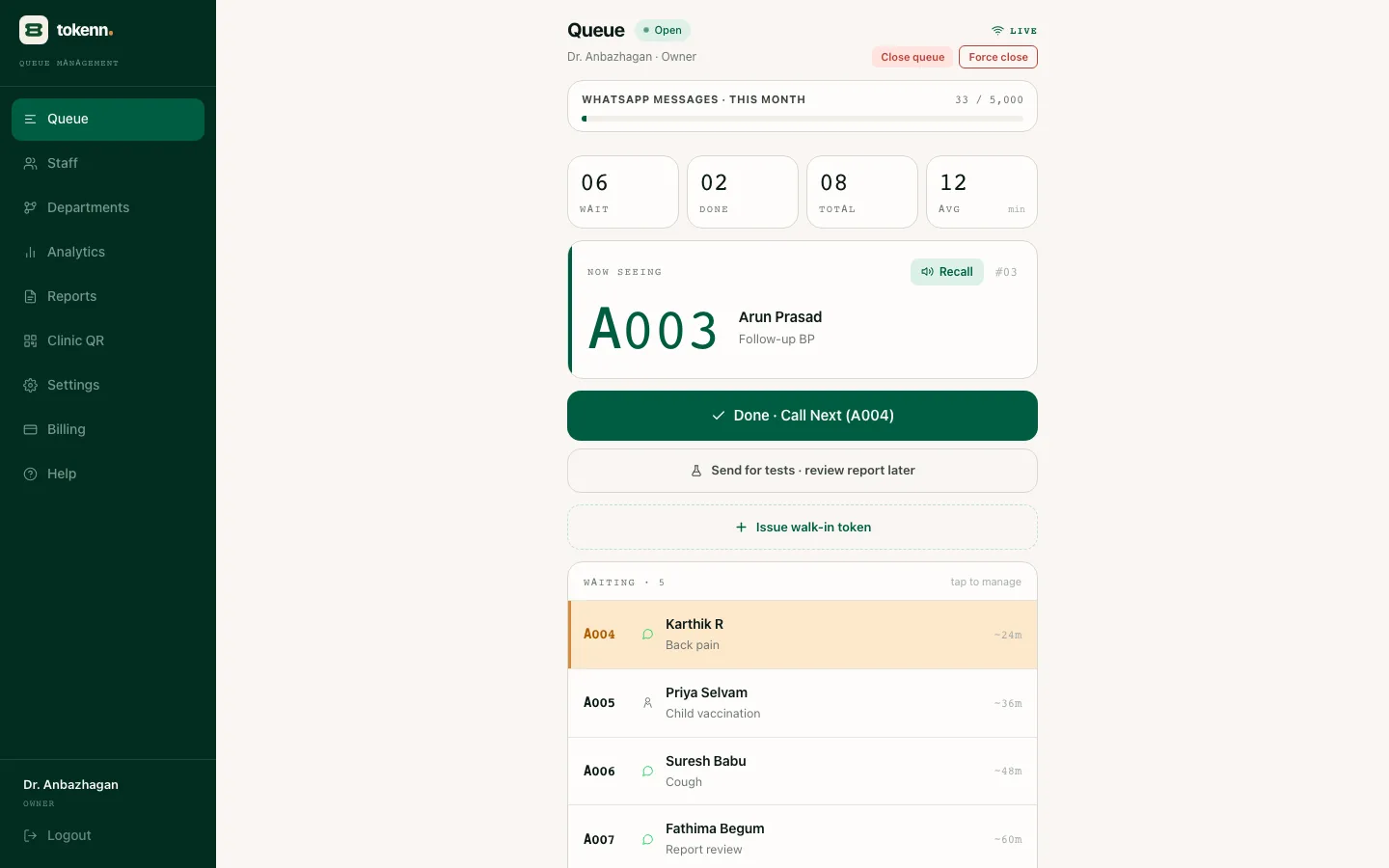
The receptionist's screen: one tap to call the next patient, two taps for a walk-in token.
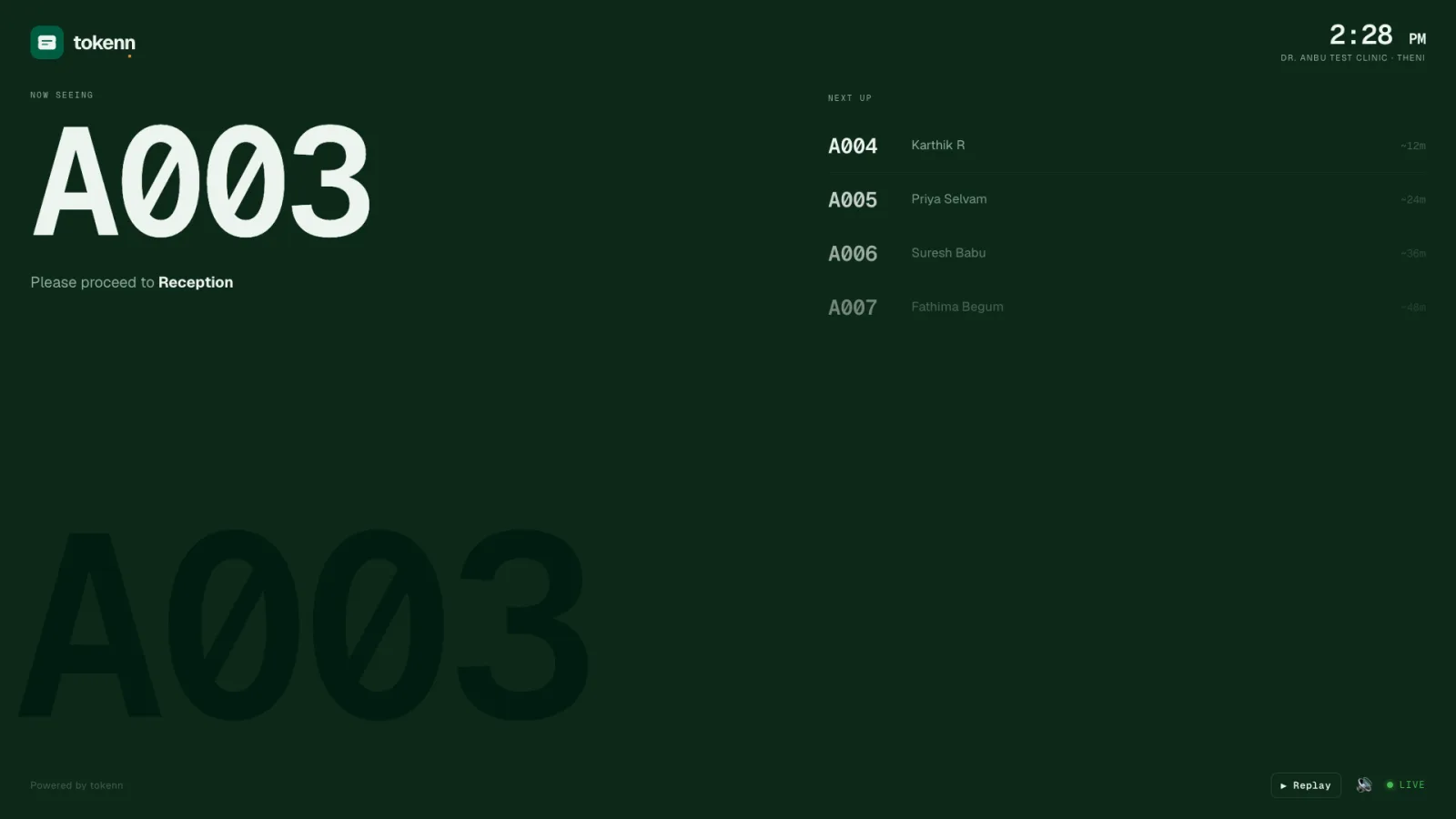
The waiting-room display on any Android TV or tablet: the token being seen, the next four, and a voice announcement for each call.
Live, not laggy
Every change pushes to the screen the second it happens. No refresh button, no stale list.
Walk-ins still welcome
An older patient without a phone gets a token in two taps and a fair place in the line.
Numbers you will actually use
Average wait, no-shows, the peak hour. Enough to decide whether you need a second evening session.
No app, no hardware, no integration project
A WhatsApp chatbot for clinic bookings, in the patient's language
Patients write however they write. Tamil script, Hindi, Telugu, Kannada, Malayalam, or "doctor hain kya?" in Roman letters. They get a token, check where they are, or cancel, all in their own words. The Tamil & Hindi chatbot page shows how it handles each language.
The "two ahead" reminder
Consults run long. Emergencies jump in. That's a normal OPD morning, and it's why patients sit there for 90 minutes not trusting their token number. TOKENN recalculates the queue as it moves. If you're running late, the "two ahead" message just goes out later, and the patient arrives later. The waiting room holds four or five people instead of twenty-five. Paper token vs digital token system, side by side.
A display on the TV you already have
No ₹50,000 kiosk. Open the display page on any Android TV or tablet and it becomes a token display system for clinic waiting rooms: the number being seen, the next few, and a voice that calls each token so nobody has to shout across the hall.
A patient queue management system your receptionist learns in a morning
Everything a solo GP needs from a queue management system for clinics, and nothing from an enterprise sales deck. WhatsApp first, on the official Meta Cloud API with a verified business profile. An AI that reads "doctor irukkanga?", "doctor hain kya?" and "available?" as the same question and answers in the language it was asked. Two-ahead and your-turn reminders. A display that speaks: open it on any tablet or TV and it calls each number out loud. Walk-in tokens in two taps. One tap brings an emergency in ahead of the line, and a report-review lane brings a lab patient back on the same token. Appointment slots for any doctor who runs on fixed times, with the visit reason taken first, typed or as a voice note, and a reminder before each slot. A scan-to-book QR for the desk, the door and your Google listing. Patients check their own position or cancel on WhatsApp. Daily numbers: tokens seen, no-shows, peak hour, average wait. Everything encrypted at rest with AES-256 on EU servers, backed up daily.
Different clinics, different queues
A pediatric waiting room and a dental chair have very different mornings. The queue follows your workflow, not the other way round.
- Pediatric clinics: sick children and worried parents wait at home until it's nearly their turn, not in a room full of other sick children.
- Dental and physiotherapy: fixed-length visits run as appointments. Patients book the chair or the session on WhatsApp and get a reminder before it.
- Diagnostic labs: send a patient for sample collection, then call them back for the report on the same token. No second line at the counter.
- OPD and general practice: patients book from home, watch the live wait, and walk in when they're two tokens away. The 9 AM rush thins out on its own.
- Multi-doctor polyclinics: a token queue or an appointment book for each doctor or department, each with its own series, hours and QR code, all on one dashboard.
- All 14 specialties: gynecology, cardiology, eye care, dermatology, physiotherapy, veterinary and more, each with its own page.
Use cases by kind of clinic are in queue management solutions for clinics.
WhatsApp tokens vs paper, kiosks and patient apps
Every clinic queue management system in India asks you to trade something. Here's the honest version of each trade, and why small clinics keep ending up on WhatsApp.
- Token kiosks and machines: ₹30,000 to ₹80,000 for the hardware, plus a yearly maintenance contract. And patients still wait in your lobby, because a kiosk can't message anyone at home.
- Patient-app queue systems: apps demo well. Then patients don't install them. WhatsApp is already on nearly every phone in India, so nobody drops out at the download step.
- Tokens or appointments: fixed slots suit fixed-length visits, and a token with a live estimate suits mornings where consults run long. TOKENN runs both, chosen per doctor.
The side-by-side pages, with real prices, are in clinic queue system alternatives.
Simple, transparent pricing for Indian practices
One price: ₹1 per patient token or appointment booking, all in, with WhatsApp messages, reminders, the TV display and every department included. Start with 150 tokens for ₹149, then top up in packs of 500 to 5,000 with bonus tokens on the larger ones. Nothing expires and there is no monthly bill. Walk-ins reception types in count too, so the bill is simply the patients you served. Patient data stays in India; a DPA is available. See full pricing and the FAQ.
Clinic queue management questions
Do patients need to download an app for Tokenn? No. Everything happens inside WhatsApp, which is already on most phones in India. Patients message your clinic number or scan the QR. No app store, no login, nothing to install.
Can Tokenn handle walk-in patients? Yes. Reception issues a walk-in token in two taps, with or without a phone number. Walk-ins join the same queue as WhatsApp bookings and show up on the display like everyone else.
Can patients book a time instead of a token? Yes, per doctor. Switch a department to appointments and patients pick a day and a free time on WhatsApp, say what the visit is for, typed or as a voice note, and get a reminder before their slot. Other doctors in the same clinic can stay on tokens.
Do appointments cost more than tokens? No. An appointment booking is ₹1, the same as a token, and the reminder is included. Rescheduling is free. A cancelled or missed booking is not refunded, the same as a token.
What happens when a booked patient doesn't come? Patients can cancel or reschedule by replying on WhatsApp, and most do. If someone has not checked in 30 minutes after their slot (longer for long slots), TOKENN marks a no-show and the slot opens up for someone else.
What about elderly patients who can't use WhatsApp? They walk in like always and get a token in two taps. Nobody gets pushed to the back for not having a smartphone.
Which languages does it understand? Tamil, Hindi, Telugu, Kannada, Malayalam, Marathi, Bengali, Gujarati, Punjabi and English, plus the Tanglish and Hinglish people actually type. It replies in the language the patient wrote in.
How long does setup take? About 2 minutes to create the clinic account, then under 10 minutes to connect WhatsApp and print your QR. Most solo GPs are live before evening OPD.
What if the AI is unsure? It asks one short clarifying question instead of guessing. Anything outside booking, status or cancelling goes to reception, and staff see every token live on the dashboard.
Is patient data safe? Encrypted at rest with AES-256, on a dedicated server in an ISO 27001 data centre in Helsinki, Finland (EU). WhatsApp access tokens use a key only your clinic holds. Backups run daily.
Am I locked into a contract? No. There is no contract and no monthly bill. You buy tokens in packs, they never expire, and you top up when you need more.
Does TOKENN work with my existing EMR or billing software? Yes. It runs alongside any EMR, HMS or billing software with zero integration. Keep your current software and add the queue on top.
What does a clinic queue management system cost in India? A token kiosk with an LED display costs ₹30,000 to ₹80,000 up front, plus a yearly maintenance contract. TOKENN is ₹1 per patient, all in: start with 150 tokens for ₹149 and top up in packs that never expire.
Your queue, sorted by tonight.
No IT visit. Your phone and the TV in the waiting room are enough. Start with ₹149 or see a live demo on WhatsApp.
Explore: queue management solutions for clinics, WhatsApp queue system features, clinic queue system alternatives, queue management software by medical specialty and all clinic queue guides.
Questions? Message us on WhatsApp. About · Privacy · Terms · Security · DPA